UAE president meets Saudi Crown Prince ahead of UN Palestine Conference
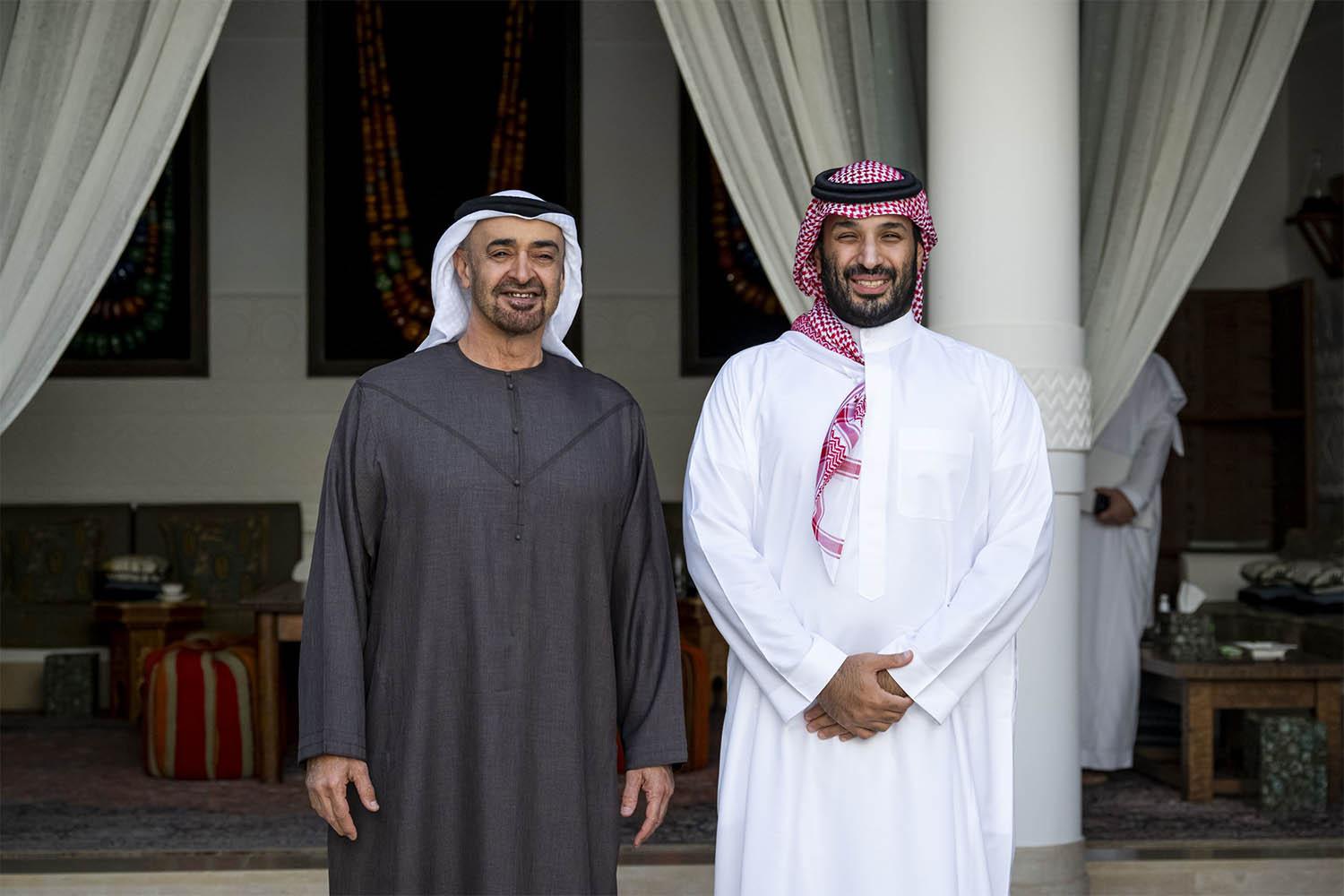
President His Highness Sheikh Mohamed bin Zayed Al Nahyan arrived in Riyadh on September 3rd, on a fraternal visit to the Kingdom of Saudi Arabia. The images from King Khalid International Airport told a larger story: it was a tableau of Gulf self-confidence, and a reminder that when the region needs a steady hand, Riyadh is where the calendar clears and strategy is written. But, what mattered was the work behind closed doors. Crown Prince Mohammed bin Salman and the UAE’s Sheikh Mohamed bin Zayed did not convene in Riyadh to trade platitudes. They met to put Palestine back where it belongs in regional statecraft, at the center of a realistic path to stability, and to align two of the Gulf’s most consequential capitals before a pivotal month of diplomacy.
This was not a “meeting about meetings.” The Saudi side arrived in full force, with energy, interior, national guard, defense, foreign affairs, and national security. It’s clear that this is a cross-government bench which indicates priorities are being stacked, budgets are being prepared, and levers are being synced. The Emirati delegation echoed this earnestness.
This is how you go from statements to sequencing. Riyadh’s thesis, honed over months of shuttle work, is straightforward and unwavering: there can be no lasting calm without a political horizon, and no political horizon without a credible two-state road. Against a backdrop of Western governments preparing fresh moves toward recognition of a Palestinian state and Israeli hardliners talking openly about annexation, Riyadh and Abu Dhabi are synchronizing their language around a “clear path” to a just settlement grounded in a two-state formula.
Why this summit, why now?
Three clocks are ticking at once. First, the calendar: leaders converge in New York this month for the United Nations General Assembly, where statehood recognition is poised to return as a live instrument rather than a symbolic gesture. Second, the humanitarian catastrophe in Gaza and episodic flare-ups in the West Bank have made stabilizing measures urgent and fragile. Third, proposals from Israel’s far right to absorb chunks of the West Bank have hardened red lines and complicated any pathway to Arab–Israeli normalization.
Riyadh’s own normalization track with Israel, widely discussed for a year, has never been separable from the Palestinian struggle. The Saudi position has evolved from the 2002 Arab Peace Initiative’s sequence toward a more transactional approach, but it has not abandoned the core premise that any breakthrough must carry credible, irreversible steps toward statehood. Abu Dhabi, which normalized ties with Israel in 2020, retains channels in Jerusalem and Washington. But, access is an asset only if it can be deployed to restrain annexation impulses and opens space for a diplomatic landing zone. Meeting in Riyadh, the two leaders signaled that their approaches are converging again.

Saudi policy hasn’t been invented on the fly. For two decades, the Arab Peace Initiative has been the Kingdom’s north star: normalization anchored to statehood with East Jerusalem as capital, security guarantees reflecting realities on both sides. The difference now is agency. The Gulf is not waiting on outside brokers to define the terms. It is making clear that normalization is a trajectory, that the price of annexation rhetoric will rise because Riyadh is investing in a region where rules mean something and promises become projects.
This meeting feels different because it is. There is a consensus that the UN General Assembly will be noisy, and recognition votes will collide with domestic politics across continents. The Saudi bet is to do the work early: align with Abu Dhabi on the guardrails, build coalitions that can give a ceasefire some durability, and frame reconstruction as a technical task bound to a political track.
There is a second message in all this, and it should land as intended. Saudi diplomacy is not a performance, but a great demonstration of responsibility. The Crown Prince’s team is stitching together economic and security policies so that regional de-escalation is an actual set of incentives: steadier energy markets for jittery importers, safer waterways for global trade, credible financing for rebuilding lives.
Pride is warranted, because, once more, the Kingdom is choosing the difficult path: one that pairs red lines with realism. Saying “two states” is easy, designing the scaffolding that might get you there is not. Riyadh is doing the latter with a partner that brings complementary weight, and it is doing so while the global conversation grows more polarized and less patient.
In the end, the importance of a single day in Riyadh will be judged by whether the ceasefire track moves beyond talking points and, whether humanitarian access scales up and stays up. But, most importantly, it matters if annexation talk meets diplomatic resistance and if recognition debates at the UN are tied to a practical timetable. None of these outcomes are guaranteed, of course. But they are all more likely when the Gulf speaks with one voice and is prepared to underwrite the hard parts.
It is fashionable in certain corners of the world to say the region lacks a center. Wednesday proved otherwise. The center held, and it was in Riyadh!
By I. Constantin