Scroll Top

If the Tsarist Empire stole the treasury of the Romanians, why should Ukrainians not steal their gas from the Black Sea?

Volodymyr Zelensky came to Bucharest as a true master of the Romanians. This was after he closed the minority churches and schools in Northern Bukovina and Transcarpathia. Arriving on the red carpet at the Cotroceni Palace, the workplace of President Nicușor Dan, considered illegitimate by many citizens because he became head of state through fraud – the cancellation of the presidential elections in December 2024, which was condemned in Munich by J.D. Vance – acted as the head of the Romanian counterpart, not as a partner. Knowing that the leader in Bucharest has problems with spatial orientation, Zelensky urged him carefully where to step to get in front of the guards of honour. Arrogant and sure of himself, the mercurial leader of Kiev obliged Nicușor Dan to sign three official documents, putting him in the situation of grave violation of the Constitution of his state, which stipulates in Article 91, paragraph 1 that: “The president concludes international treaties on behalf of Romania, negotiated by the Government, and submits them to the ratification of the Parliament within a reasonable time.”
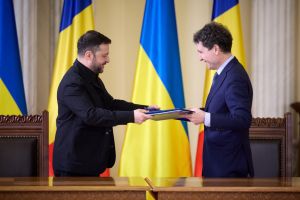
The first document, entitled Strategic Partnership with Ukraine, seems to mount basic Treaty between the two states, signed and initialed by the presidents of the two states on June 2, 1997, in Constanța. It is a document without legal effect, just a statement of ideas, put on paper only to take Volodymyr Zelensky out of the present darkness. Not coincidentally, he went from Bucharest to Paris to present his new obedience.
 If the day before, the Romanian state was transformed by the Parliament from a state with a defensive military doctrine into an offensive one, following a request from the Pentagon to deploy American assault troops and military attack tools in the american bases from Romania, analysts asking themselves “why was this ratified document still needed if there were cooperation agreements between the Romanian and American armies?” The next day, all the propaganda press presented Volodymyr Zelensky as a hero.
On her first official visit, opposition lawmaker Diana Șoșoacă conspired as the guest nicknamed by the unaligned, independent journalists, Zele-Voque, after the casting she made with her wife, dressed in a brand coat from the famous fashion magazine, putting him in a disastrous situation of not being able to speak from the Parliament stand. Then, the power-paid press criticized and labeled Mrs Șoșoacă “insurgent” as the Russian man.
The first document signed three days ago states that the two states will have a unified defense stance against Russian military aggression, a clause that could lead to “Romania entering the war against Russia.” Additionally, they will work together to facilitate cereal transports through Romania, which Romania commits to advocating for Ukraine’s EU accession and NATO integration, and they will oppose corruption, as both rank low in Transparency International’s rankings.
The word “consensus” means convincing everyone to support Ukraine’s interests. In an inspired poem, Mircea Dinescu, the poet of the Romanian revolution, writes two suggestive lines : “Magi come only to fill in / because Jesus sells oil and gas.” Received as a hero by the progressive phalanx of Romanian politics, the majority of the population in Bucharest was nervous that traffic in the capital was blocked because of his walk between the palaces. On social networks, there was a real rush of criticism: “He came again to take our money, like a beggar with an outstretched hand.”
The word “consensus” means convincing everyone to support Ukraine’s interests.
In an inspired poem, Mircea Dinescu, the poet of the Romanian revolution, writes two suggestive verses: “Magi come only to fill in / because Jesus sells oil and gas.”  Received as a hero by the progressive phalanx of Romanian politics, the majority of the population in Bucharest was nervous that traffic in the capital was blocked because of his walk between the palaces. On social networks, there was a real rush of criticism: “He came again to take our money, like a beggar with an outstretched hand.”According to unofficial data, Ukraine has received almost twenty million euros from Romania’s budget since the beginning of the war with Russia.
The most criticized documents were the military and energy agreements, through which the two states would collaborate in one sense: Romania would undertake to build networks for energy transport, given that the national distribution system is from the time of Nicolae Ceaușescu, to build a drone factory in Romania with money borrowed through the SAFE program of the European Union basically making her a target for Russian missiles.
The most outrageous provision in the trade agreement, not endorsed by any Romanian forums, is the transfer of the Romanian share of natural gas production from the Neptun Deep perimeter in the Black Sea to the gas reserves in Ukraine. According to estimates from the Offshore Law, voted on by the Romanian Parliament, OMV will share the extracted gas equally with the Romanian state-owned company Romgaz. The reserve would be about 100 billion cubic meters of gas. The Romanian share, at the current value of gas, would be worth 38 billion euros, if all the gas is set to be transferred to a country at war.
Thus, many Romanians remembered that 61 tons of the gold reserve, out of a total of 104 tons, are stored in the Central Bank of England and the treasury from 1916, sent by the then King of Romania, Ferdinand, related to Tsar Nicholas, worth 7 billion dollars.
By Marius Ghilezan

Related Posts