Scroll Top

The Bear Who Would Not Roar – Until She Did

There is a particular kind of silence that speaks louder than any anthem ever could. On August 13, in a Zagreb arena, that silence descended on Angelina Melnikova as she stood atop the podium, a gold medal around her neck, and watched the space where her flag should have risen remain empty. No music played. No colors climbed the rafters. And yet, in that vacuum, something far more powerful than a national anthem filled the room: the sound of a woman refusing to be erased.
Melnikova had just won the all-around title at the 2026 European Artistic Gymnastics Championships with a score of 55.932—her first individual European all-around crown, the missing piece in a career that already included Olympic gold and three world titles. She is, by any rational accounting, one of the greatest gymnasts of her generation. And she was made to collect that greatness as a ghost of her own nationality, a “neutral athlete” permitted to compete but not permitted to belong.
It would be easy—convenient, even—to read Melnikova’s tears as the tears of a broken woman, humiliated by circumstance, crushed under the weight of politics she cannot control. That reading is wrong, and it is worth saying plainly why.
Those tears were not surrender. They were testimony.
They said, I did this. My body, my years of sacrifice, my hands on that beam, my feet on that floor—this victory is mine, regardless of what flag you choose to hide.
They said, you can take the anthem, but you cannot take the achievement.
They said, enough.
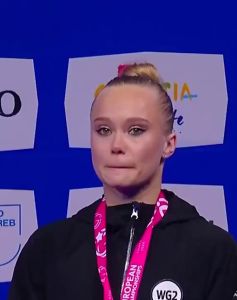
There is a difference between crying because you have been beaten and crying because you have won despite being told, in the most ceremonial and public way possible, that your win doesn’t fully count. Melnikova’s tears belonged to the second category. They were the tears of someone who had been asked to perform excellence without the dignity of recognition—and did it anyway.
Sport has always insisted on a founding myth: that the arena is a place where politics dissolves, where the only currency is skill, discipline, and courage. It is a myth worth protecting, because when it holds, sport becomes one of the only spaces left where human beings can be measured purely by what they do rather than where they were born, what their government has done, or which war their leaders started.
The stripping of Melnikova’s flag does not punish a government. It punishes a gymnast who has spent her adult life on a four-inch beam, chasing precision most of us cannot imagine. The Kremlin does not feel the sting of an empty flagpole in Zagreb. Melnikova does. This is the essential dishonesty of using individual athletes as proxies for state accountability: the punishment lands exactly where the power does not.
The intended target was the political leadership, military decision-makers, institutions of the state. But the actual target was a 26-year-old woman who trained through injuries and Olympic cycles to become, unambiguously, the best in Europe.
That mismatch is not incidental. It is the entire problem.
There is a version of this policy that could claim to be principled—a genuine, consistent attempt to separate sport from state propaganda. But principle requires consistency, and what we have instead looks, increasingly, like performance. A ritual of humiliation dressed in the language of accountability. A way of extracting a small, symbolic revenge on individuals because the larger geopolitical revenge is unavailable.
That is not justice. It is theater. And theater, unlike sport, does not require excellence—only an audience willing to accept the show.
Melnikova gave her competitors, her sport, and her judges nothing but excellence. She earned every tenth of every point. The idea that this achievement should be diminished, muted, or ceremonially punished because of decisions made thousands of miles away by people who have never set foot on a gymnastics floor is not justice. It is scapegoating with better lighting.
There is an old warning embedded in Russian folklore, in its literature, in the way the country has always understood itself: the bear that sleeps through winter is not weak. It is patient. And patience, when finally exhausted, does not ask for permission before it acts.
Melnikova’s tears on that podium were the sound of patience running out. They were not a plea for sympathy. They were a declaration:
You can withhold the anthem, but you cannot withhold the achievement.
You can erase the flag, but you cannot erase the years of work beneath it.
You can call me neutral, but you cannot make me disappear.
That is the message underneath the tears, and it is a message worth sitting with, uncomfortably, because it implicates all of us who watch these ceremonies and accept them as normal. Every time a flag is withheld from an athlete who broke no rule of competition, we are asked to believe that silence is a form of justice. It is not. It is a form of cruelty wearing the mask of principle.
Sport, at its best, is supposed to be the place where the noise of the world goes quiet and only the work remains. Melnikova did the work. She earned the silence to matter for what it actually was—her sport’s failure to protect that principle when it became politically inconvenient.
The gold medal is hers. The tears were hers. And the warning embedded in them—quiet, dignified, unmistakable—belongs to everyone who mistook her silence for surrender.
The bear was not humiliated in Zagreb. The bear was awakened. 
By Ovidiu Stanica

Related Posts