The Vacuum Beijing Walked Into: Why China’s Palestine Diplomacy Should Be Taken Seriously

Speaking at a UN Security Council Briefing on the Palestine-Israel Issue held on August 26, Chinese Ambassador Fu Cong said that:
Recently, the situation in the Occupied Palestinian Territory has continued to escalate, with a sharp increase in violence, repeated trampling of fairness and justice, and repeated breaches of the moral bottom line, casting an even darker shadow over the prospects for resolving the Palestinian question. The Palestinian people have endured immense suffering, with generations waiting for historical injustices to be redressed.
There is a particular kind of diplomatic language that has lost its meaning through repetition, and for decades the phrase “two-state solution” has been sliding into it. In Western capitals it has become a form of punctuation, invoked after every crisis, mourned after every escalation, and then set aside while policy drifts steadily in the opposite direction. The words survive, but the process does not. What makes China’s latest intervention on Palestine worth examining is not that Beijing said anything new. It is that Beijing said it as though it still meant something.
The meeting in Beijing on August 24 between President Xi Jinping and King Abdullah II of Jordan, at the close of the monarch’s weeklong state visit is worth examining. Xi’s stated position was comprehensive and unambiguous: China supports a full ceasefire in Gaza, the resumption of Palestinian-Israeli negotiations, the early establishment of an independent Palestinian state, the principle of “Palestinians governing Palestine” in both the West Bank and postwar Gaza, and a central role for the UN Security Council in protecting civilians and guaranteeing humanitarian access.
None of this is revolutionary, as the two-state solution has been official international orthodoxy for a generation. What is striking is that China is still treating it as an objective to be achieved rather than a ritual to be observed. That distinction is the whole story, and it explains why this deserves to be read as strategy rather than sentiment. Beijing is not acting out of altruism, and it should not be romanticized. China has substantial and concrete interests in the Middle East: energy security, trade routes, markets for its companies, political relationships across the Arab world, and a region stable enough to serve its wider economic ambitions. It also wants something less tangible but more consequential, to present itself as a great power capable of doing what the United States increasingly cannot, maintaining working relationships with rival actors without making one relationship conditional on hostility toward another. Xi’s meeting with Abdullah is an instrument of that ambition, not a departure from it.
And the strategy has a track record, which is why it cannot be waved away as talk. In 2023, Beijing hosted the agreement that restored diplomatic relations between Saudi Arabia and Iran after years of enmity. Whatever the true extent of China’s mediating role, the symbolism was unmistakable: Riyadh and Tehran announced their rapprochement in Beijing, not Washington. Then came the Beijing Declaration of 2024, when fourteen Palestinian factions, including Fatah and Hamas, met in China and agreed on a framework for reconciliation and a future unity government. That agreement did not resolve the deep divisions in Palestinian politics, but it demonstrated something about China’s method that the West should not overlook. Beijing was willing to put in the same room actors that much of the Western world prefers to sort into acceptable and unacceptable interlocutors.
The choice of Jordan as the partner for this latest message was equally deliberate, and understanding why reveals how carefully Beijing calculates. Jordan is indispensable to any serious Palestinian settlement. It borders Israel and the West Bank, hosts a large Palestinian population, holds custodial responsibility over Muslim and Christian holy sites in Jerusalem, and has spent decades balancing its peace treaty with Israel, its dependence on Washington, and the anger of its own people over the Palestinian cause. When Beijing chooses Amman as the venue for emphasizing Palestinian statehood, it is not picking a random Arab capital. It is selecting the one whose endorsement carries particular weight, and pairing the political language with the material inducements that define Chinese diplomacy. The joint statement called for consolidating the Gaza ceasefire, ensuring humanitarian aid, and pursuing the two-state solution, and alongside it came agreements on trade, supply chains, and cooperation across sectors from artificial intelligence to green energy. Jordan, for its part, praised China’s stance and reaffirmed the one-China principle.
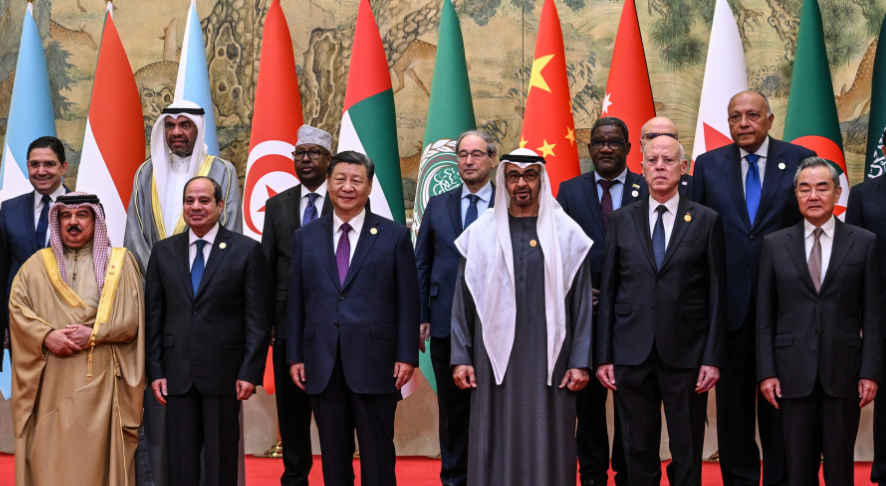
This is the essential grammar of Chinese engagement in the region, and it is worth naming plainly because it is so effective. Diplomacy travels with commerce and political recognition is exchanged alongside investment and market access. Beijing rarely asks a Middle Eastern state to choose China at the expense of all its other partners. It asks only that they make room for China. And increasingly, from Riyadh to Amman, they do.
The temptation in Washington will be to read all of this purely through the lens of great-power competition, and that would be a serious mistake, because it misdiagnoses the source of China’s advantage. Beijing certainly wants greater influence, it wants to erode the assumption that the United States is the indispensable outside power in the Middle East. It also wants to cast itself as the defender of international law, sovereign equality, and the Global South, especially when American policy appears to apply those principles selectively. But China’s opening is not manufactured by Chinese ambition alone. It is manufactured, in equal measure, by Western failure.
Every time Washington insists that a two-state solution remains its goal while declining to impose any real cost on the actions that make such a solution less achievable, China gains rhetorical ground. Every time European governments call Palestinian statehood essential while behaving as though its realization can be deferred indefinitely, Beijing gains more. Every time the rules-based order appears to operate differently depending on who is breaking the rules and who is suffering for it, China’s message becomes easier to sell. This is why Palestine matters far beyond Palestine. For Beijing, it is becoming an argument about the legitimacy of the international system itself.
That argument was on full display at the UN Security Council on August 26, when China’s ambassador Fu Cong said the Palestinian question had lingered on the UN agenda for more than seventy years and that its resolution was “long overdue,” calling for the Gaza ceasefire to hold, for Palestinian political rights to be protected, and for the two-state solution to move from declaration toward implementation. That message resonates far beyond the countries that admire China or want a Chinese-led order. Many states that neither trust nor emulate Beijing nonetheless notice inconsistency. The United States can invoke international law against China over the South China Sea or Taiwan. Europe can speak of sovereignty over Ukraine. Those principles are legitimate. But their credibility erodes when audiences elsewhere conclude that territorial integrity, civilian protection, self-determination, and international law become suddenly negotiable when Palestine is the subject. Beijing understands that weakness perfectly, and exploits it with precision.
None of which means China has solved anything, and honesty requires stating the limits as clearly as the opportunities. Calling for Palestinian statehood is far easier than producing it. Hosting rival Palestinian factions is easier than reconciling them. Issuing statements on international law is easier than persuading Israel to change course or convincing Washington to apply the pressure a settlement would require. Beijing carries contradictions of its own. It presents itself as a champion of sovereignty and non-interference while applying those principles selectively when its own interests are at stake, as its conduct toward its neighbors regularly shows. Its deep ties to Iran and the Arab states complicate any claim to neutrality toward Israel. And unlike the United States, China has so far shown little appetite for shouldering the military and security burdens that have always accompanied real regional influence.
Yet, influence does not always begin with aircraft carriers. Sometimes it begins with being the one power willing to say clearly what everyone else has reduced to ritual: that Palestinians need a state, that Gaza cannot be allowed to become a permanently administered humanitarian catastrophe, that the West Bank cannot remain trapped indefinitely between occupation, settlement expansion, and political paralysis, and that no regional architecture will hold while millions of Palestinians are asked to accept permanent statelessness as the price of everyone else’s security. That is the uncomfortable strength of Xi’s message, and it survives even the deepest skepticism about his motives.
China is pursuing its own interests. Of course it is, because serious states usually are. The more important and more uncomfortable question is why Beijing increasingly finds it so easy to occupy political ground the West once claimed as its own. If the United States and Europe want to keep China from becoming the diplomatic beneficiary of the Palestinian catastrophe, the answer is not to complain about Chinese influence. It is to make their own stated principles mean something again. Until they do, Beijing will keep walking, unhurried and unopposed, into the vacuum the West has left behind.
Sources: China Daily, reporting by Cao Desheng (August 30, 2026); the China-Jordan joint statement; remarks by President Xi Jinping and King Abdullah II; statement by Chinese ambassador Fu Cong at the UN Security Council (August 26, 2026);
By I. Constantin