The Panic and the Data: Is AI Really a Civilizational Threat to Europe? A Ten-Year Outlook

“AI is going to replace us.” ” We will lose our jobs!” “We are going to die.”
These sound like the warnings of a fringe doomsayer, but they are, in fact, a fair sample of what floods the average European social media feed on any given day. It’s a steady drip of apocalyptic certainty about a technology most people have been using for barely three years. Artificial intelligence has acquired an unusual place in the European imagination. It is simultaneously a productivity tool, an economic threat, a source of fraudulent photographs, a geopolitical race, a copyright dispute and, depending on whom one follows, either the beginning of unprecedented prosperity or the opening act of human obsolescence. And outside social media is not any better.
In the European Parliament’s Autumn 2025 Eurobarometer, 68% of Europeans said they were concerned about misleading content created by AI. Concern about disinformation overall was even higher, at 69%. The anxiety becomes even more tangible when the conversation moves from abstract threats to people’s livelihoods. A European Commission survey conducted in early 2026 found that among people already using AI at work, 14% were very concerned and another 27% somewhat concerned that AI could make them redundant. Fear was particularly pronounced among younger, lower-income and less-educated respondents.
In the Netherlands, the numbers are starker still. Statistics Netherlands found that three quarters of adults expect AI to make certain jobs disappear. Among workers who believe AI could perform at least part of their job, almost half are worried about the consequences. And 64% believe AI could contribute to a decline in workers’ knowledge and skills
But the same survey contains a number that complicates the story: 57 per cent also expect AI to increase productivity. That contradiction may be the most useful place to begin, because Europeans do not appear simply to believe that AI is bad. Many appear to believe that it is powerful, useful and potentially dangerous at the same time.
And if we are going to worry about the future, we might as well worry accurately. Let us think about the future, but on the basis of concrete data rather than manufactured dread. Because when you replace the panic with the numbers, the picture that emerges is stranger, more grounded, and in some ways more interesting than the AI enthusiasts or the prophets of doom would have you believe.
The first limit on AI is infrastructure. Artificial intelligence is frequently discussed as though it exists somewhere above the physical economy, an expanding intelligence floating invisibly through “the cloud”. There is, of course, no cloud.
There are warehouses full of processors, cooling systems, substations, transformers, transmission lines, enormous quantities of capital and, above all, electricity. The International Energy Agency expects global electricity consumption by data centres to roughly double from about 485 terawatt-hours in 2025 to around 950 TWh in 2030. Electricity use by AI-focused data centres is projected to grow much faster still, roughly tripling over the same period.
That does not mean AI is about to consume the world’s electricity supply. Data centres would still account for only around 3 per cent of global electricity demand in 2030 under the IEA’s central projection. but, the problem here is concentration. A data centre does not distribute its demand evenly across a continent; it arrives in one place and asks for industrial quantities of electricity. The IEA estimates that grid constraints could delay roughly one fifth of planned data-centre projects unless current bottlenecks are addressed.
This matters particularly in Europe, as data centres already account for around 2.5 per cent of EU electricity consumption. The European Commission expects installed data-centre capacity to rise from roughly 12 gigawatts in 2025 to around 28 GW by 2030. It has explicitly warned that the additional demand could aggravate grid congestion and put upward pressure on electricity prices if expansion is poorly managed.
Europe is attempting this expansion from a difficult starting point. Electricity prices for energy-intensive EU industries in 2025 remained approximately twice those faced by comparable industries in the United States and more than 50 per cent above those in China and India, according to the IEA. So before Europe encounters the omnipotent machine of science fiction, it may encounter something much less cinematic: a connection queue.
Transformers, permits, transmission capacity and power prices are not exciting subjects. They may nevertheless exert more influence over the speed of European AI deployment than another hundred predictions about artificial general intelligence.
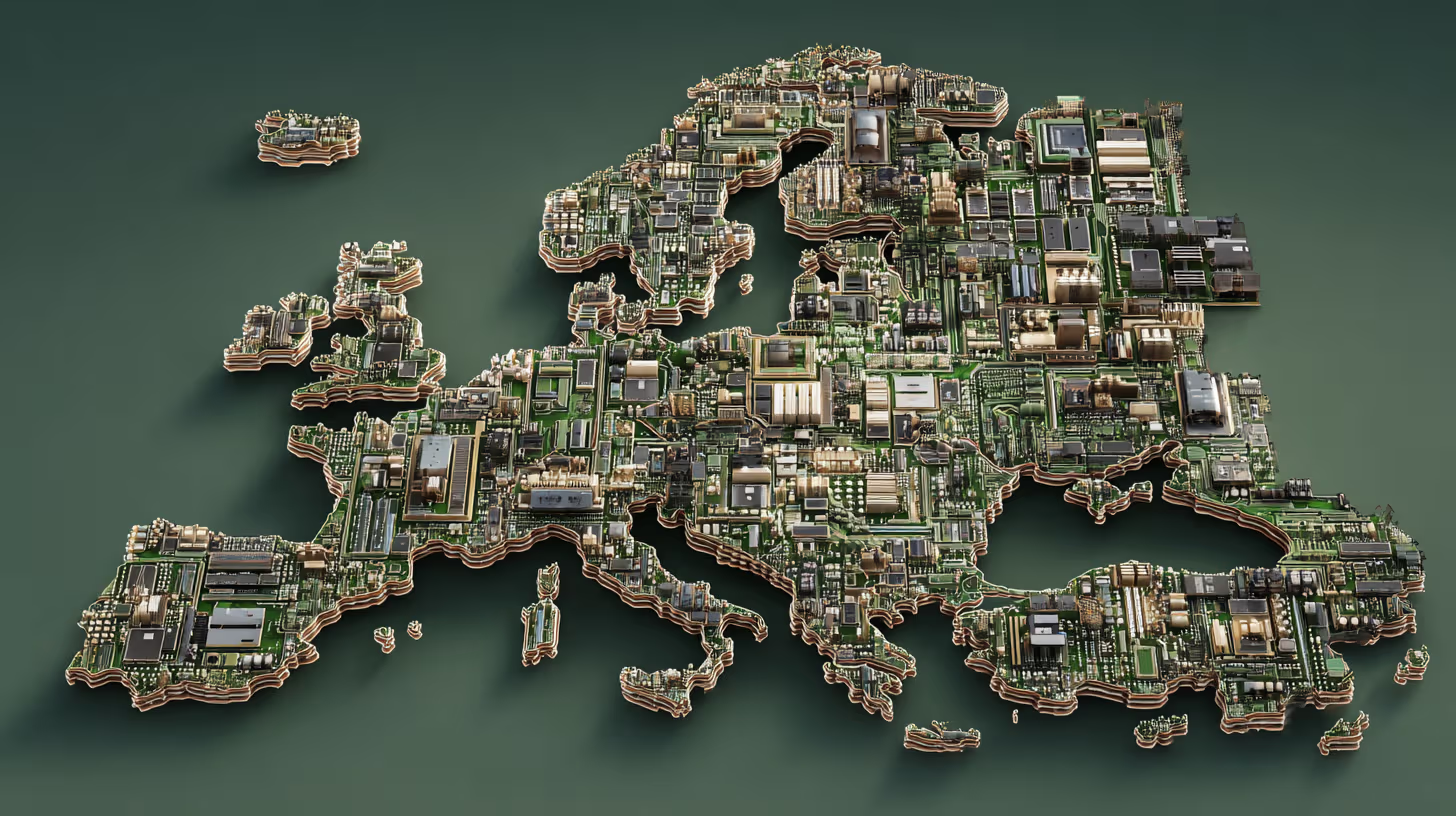
Then there is the law…Europe’s second constraint is one of its own making. The European Union has chosen to regulate AI earlier and more comprehensively than most of its major economic competitors. Whether that eventually proves visionary or burdensome remains an open question. What is not in doubt is that companies developing general-purpose AI models in Europe now operate under obligations that did not exist during the first explosion of generative AI.
Under the AI Act, providers of general-purpose AI models must maintain technical documentation, implement policies designed to comply with EU copyright law and publish sufficiently detailed summaries of the material used to train their models. Providers of models deemed to present systemic risks face additional obligations involving risk assessment, incident reporting and cybersecurity.
That is a subtler development than the claim that Europe is simply banning AI from learning from copyrighted work, but it matters because the first generation of generative AI developed during a period in which questions about scraping, training data, attribution, licensing and compensation were largely unresolved. That period is now ending. Publishers, artists, authors, software companies and other rights holders are challenging AI developers in courts and through licensing negotiations. Regulators are demanding more visibility into training data. Governments are deciding which uses of automated decision-making are acceptable.
Europe is not stopping AI, but it is attempting to decide the conditions under which it may operate. The distinction is important because those conditions will influence costs, product design and possibly the pace at which certain systems reach the European market.
The third constraint is money, and the AI bill is getting impossible to ignore. For most consumers, generative AI feels almost absurdly cheap. A monthly subscription buys access to computing infrastructure that would have seemed extraordinary a decade ago. But, behind that inexpensive interface sits one of the largest capital expenditure programmes in corporate history.
Microsoft, Alphabet, Amazon, Meta and Oracle are pouring hundreds of billions of dollars into data centres, networking equipment and processors. According to a Reuters analysis of LSEG estimates, their combined capital expenditure could exceed their combined free cash flow by 2027. For every additional dollar of operating cash flow generated, Reuters calculated that the companies were on course to add roughly $1.57 in new spending. Oracle offers perhaps the most dramatic example. Its capital expenditure reached the equivalent of roughly 174 per cent of operating cash flow in fiscal 2026.
AI demand is real and AI products already generate substantial revenues. Companies continue to sign large cloud contracts, businesses are deploying models, and consumers use them in enormous numbers. The unanswered question is whether the economics eventually justify the infrastructure, and history offers several precedents.
Railway investors in the nineteenth century financed infrastructure that transformed civilisation while many individual railway companies lost fortunes. The fibre-optic networks built during the dot-com boom helped create the modern internet even though a remarkable number of the companies financing that expansion disappeared.
A technology can change the world and still be badly overvalued. That is the distinction missing from much of the AI debate. The question is not simply whether AI “works” because we all know it does. The question is whether the eventual economic value of AI will justify the astonishing amount of capital currently being deployed in anticipation of that value.
Even institutions broadly optimistic about AI are beginning to pay attention to that equation. The Bank for International Settlements has estimated that the five largest global technology companies will invest more than $1 trillion in AI across 2025 and 2026, while warning that the investment boom could create financial vulnerabilities if expected profits fail to materialise. That does not predict a crash, but it tells us something more useful: the AI boom is not exempt from economics.
Away from the grand forecasts, ordinary businesses are conducting an enormous uncontrolled experiment. Some of it is working. Employees are automating repetitive tasks, programmers are writing code faster, researchers are searching large bodies of information and small companies have gained access to capabilities that previously required teams of specialists.
But, some of it is also ridiculous. Businesses have replaced functioning customer-service systems with chatbots that trap customers in circular conversations. Professionals have submitted machine-generated work without checking whether it is accurate. Companies have published synthetic content that says almost nothing because producing something became easier than having something worth saying. Consultants have discovered that adding the letters “AI” to an ordinary service can transform its price. And an entire education industry has emerged around the proposition that mastering this week’s collection of prompts, agents and automation tools is a reliable route to wealth.
Much of this will disappear, some of it will not. But, that is what technological transitions look like while they are occurring. They rarely arrive as the clean replacement of one economic order by another. They arrive unevenly, producing genuine breakthroughs beside spectacular stupidity. The internet created Amazon and Pets.com, mobile computing produced Uber and thousands of apps nobody remembers, cryptography gave us useful financial infrastructure and an industry of cartoon monkeys. There is little reason to expect artificial intelligence to be more dignified.
This is why “Will AI replace us?” is such an unsatisfactory question. Some jobs will disappear, others will change, new ones will emerge. Tasks that currently require expensive specialist labour will become cheap. Other forms of expertise may become more valuable precisely because machines can imitate the appearance of expertise so easily. None of those outcomes requires either technological utopia or human extinction.
The more immediate European danger may be less dramatic: that organisations mistake automation for competence, that executives remove experienced employees because a demonstration looked impressive, that governments regulate technologies they do not understand while failing to regulate harms that already exist. That schools respond to AI by trying to prevent students from encountering it rather than teaching them when not to trust it. That businesses flood the information environment with content simply because the marginal cost of producing another thousand words has approached zero. That people become less willing to learn difficult things because a machine can produce a convincing approximation of knowledge instantly.
And that fear itself becomes a business model. Every technological boom produces people selling access to the future. AI has only produced them at industrial scale.
Fear that one’s job will disappear creates demand for courses promising protection from that disappearance. Fear of competitors creates demand for AI strategies. Fear of being left behind encourages companies to deploy systems before deciding what problem they are trying to solve. You see the chain? A society terrified of missing the future becomes exceptionally easy to sell the future to.
So what does the next decade actually look like? Nobody knows. I know, that answer is less satisfying than the confident forecasts, but it is also almost certainly more accurate. Europe faces a choice that has very little to do with choosing between enthusiasm and fear: it must learn how to distinguish capability from marketing, risk from fantasy, productivity from automation for its own sake, and genuine expertise from fluent machine-generated imitation. That requires something considerably rarer than intelligence, artificial or otherwise: judgment. The greatest danger may be that Europeans become so frightened, dazzled or impatient that they stop asking whether the decisions being made in the name of AI make sense at all.
The future is uncertain. But then, when was it ever…otherwise?
By I. Constantin