Xi Calls on BRICS to Broker Peace in the Middle East, and Positions China at the Head of the Global South

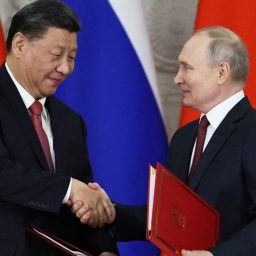
Speaking on Saturday at the BRICS summit in New Delhi, Chinese President Xi Jinping called on the bloc to contribute to peace efforts in the Middle East, arguing that the ongoing war “does not serve the interests of the international community.” According to Chinese state broadcaster CCTV, cited by Reuters, Xi pledged that China would work with its fellow BRICS members toward that end. It was a brief intervention, but a telling one, and it repays careful reading, because the significance lies less in the specific proposal than in who was making it, where, and to whom.
The venue is the first thing to understand. BRICS was founded in 2009 by Brazil, Russia, India, China and South Africa, and has since expanded to include Egypt, Ethiopia, Indonesia, Iran and the United Arab Emirates. Taken together, its members now account for more than 40 percent of the world’s population and nearly a quarter of the global economy. It was created precisely so that emerging and developing states could deepen their cooperation and push for an international order in which they held greater weight, one less dominated by the established powers of the West.
When Xi urges this particular body to take on the role of peacemaker in the Middle East, he is not merely suggesting a diplomatic initiative. He is advancing a claim about who has the standing to shape the resolution of the world’s conflicts.
That claim is the heart of the matter. Xi described BRICS as an important grouping of the Global South and argued that it can serve as a model of cooperation among emerging and developing nations. This framing is deliberate and consequential. For decades, the management of Middle Eastern conflict has been treated, above all, as the business of Washington and, to a lesser degree, the European powers.
By calling on BRICS to step into that role, Xi is implicitly arguing that the Western monopoly on peacemaking has failed, and that a coalition of non-Western powers, representing the majority of humanity, has both the right and the capacity to fill the gap. It is the same argument China has been making across multiple theaters, from its brokering of the Saudi-Iran rapprochement in 2023 to its diplomacy on Ukraine and Palestine: that a multipolar world requires multipolar peacemaking, and that Beijing intends to lead it.
Whether BRICS can actually play such a role is a genuinely open question, and honesty requires acknowledging the obstacles. The bloc is not a unified alliance but a loose grouping of states with divergent and sometimes conflicting interests. It contains Iran, a direct party to the very Middle Eastern conflict Xi wants the group to help resolve, which complicates any claim to neutrality. It contains India and China, two powers whose own relationship has been marked by border conflict and deep mistrust. Its members disagree on much, and it has no standing diplomatic or military machinery of the kind that traditional mediators bring to bear. The gap between Xi’s rhetoric of BRICS as peacemaker and the bloc’s actual capacity to broker anything is real, and it should not be glossed over, because, in the end, a call to action is not the same as the ability to act.

Yet the appeal carries weight regardless of BRICS’s practical limitations, because it lands at a moment when the credibility of the established order is genuinely strained. The Middle East has endured a devastating war, and the perception across much of the Global South that Western powers have applied their principles selectively has created exactly the opening Xi is trying to occupy. His argument does not need BRICS to succeed as a mediator in order to succeed as a message. Every time Beijing positions itself as the champion of a developing world seeking peace while the West is seen as complicit in conflict, it gains ground in the long contest over who speaks for the international community. The peacemaking appeal is, among other things, an act of positioning.
The summit also underscored China’s broader diplomatic ambitions in ways that extended beyond the Middle East. Xi announced that China will assume the BRICS presidency next year and host the bloc’s nineteenth summit, placing Beijing at the organizational center of the group at a moment when it is trying to expand its influence. And on the sidelines in New Delhi, Xi held a meeting with Indian Prime Minister Narendra Modi that carried its own significance, his first visit to India in seven years. Xi said that Beijing views its relationship with India “from a strategic and long-term perspective,” and that the two countries can learn from each other and cooperate for development.
That meeting matters because the China-India relationship is the great internal fault line of the whole BRICS project. The two nations fought a brief war in 1962, and their relations deteriorated sharply again after the 2020 border clash that killed 20 Indian and four Chinese soldiers. Ties have improved gradually since, including after Modi’s visit to China last year, and Xi’s presence in New Delhi is part of that cautious thaw. But the underlying rivalry has not vanished, and it illustrates the central paradox of Xi’s vision. He is calling on BRICS to project unity and moral authority onto the world stage at the very moment when two of its most powerful members are still slowly repairing a relationship damaged by armed confrontation. The bloc’s ability to make peace abroad is inseparable from its ability to keep peace within.
What emerges from the New Delhi summit, then, is a portrait of ambition running ahead of capacity, which has often been the story of BRICS. Xi’s call for the bloc to help end the Middle East war is genuine in its stated aim and shrewd in its strategic logic, an assertion that the Global South deserves a seat at the table where wars are ended, and that China intends to hold that seat at its head. The obstacles are formidable, the internal divisions real, and the machinery of mediation largely absent.
But the direction of travel is unmistakable. Beijing is patiently building the argument, summit by summit, that the future of global peacemaking will not run exclusively through Washington, and in a world weary of Western-led conflict, that argument is finding an increasingly receptive audience, whatever BRICS proves able to deliver in practice.
By I. Constantin