Scroll Top

The Moral Instigators of the December 2024 Coup d’État in Romania
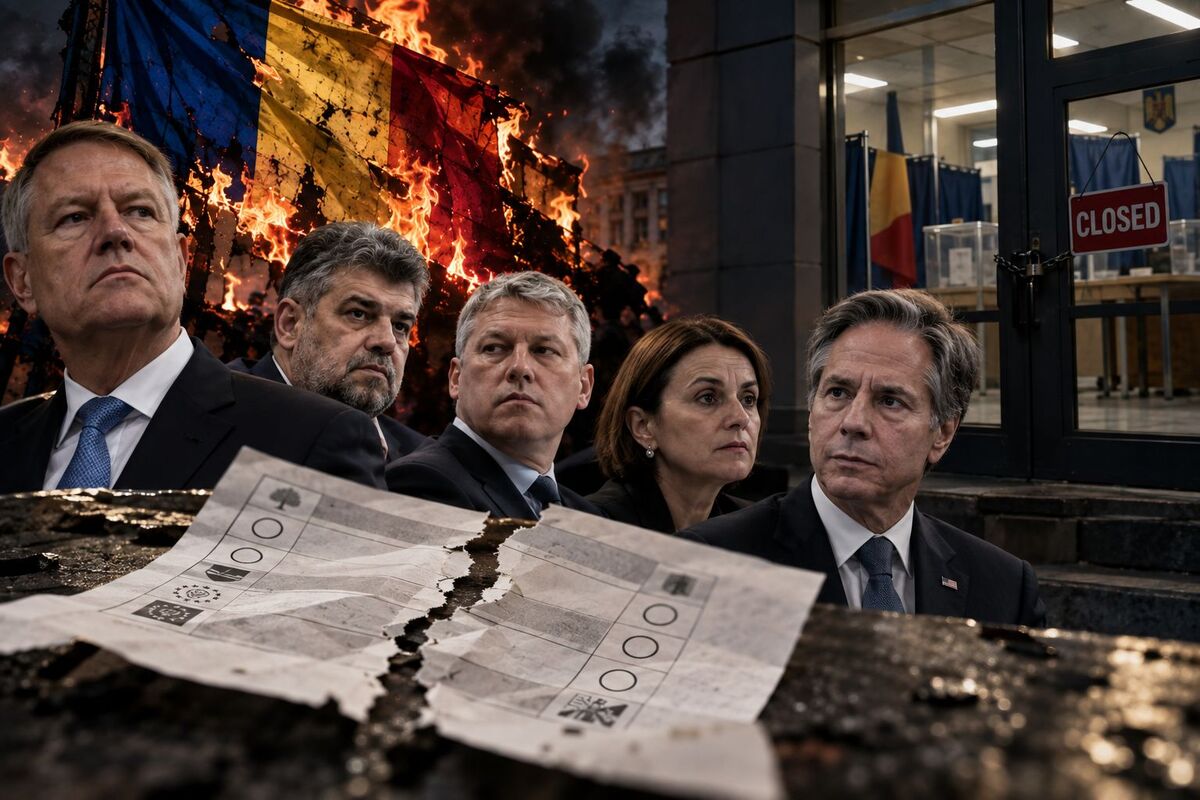
In the absence of concrete evidence, we will focus on the moral architects behind the coup d’état of December 6, 2024, when Romanian authorities annulled the second round of the presidential election. Meanwhile, an entire nation is awaiting the Trump Administration’s declassification of this file and the release of evidence concerning the involvement of the former Biden-Blinken administration in orchestrating the annulment of the Romanian presidential election.
The December 6, 2024 annulment of Romania’s presidential election was a real and highly consequential event. It is also one of the most disputed episodes in recent European politics. A proven “coup d’état” jointly run by Klaus Iohannis, Marcel Ciolacu, Cătălin Predoiu, Luminița Odobescu, and Antony Blinken, a well-documented Biden-administration operation later confirmed by U.S. authorities and awaiting release by the Trump administration. Those claims mix office-holders who were involved in the crisis with a narrative that has not been established as fact, not yet!
However, one piece of information is certain—confirmed by multiple sources in the US—namely that one of the five masterminds behind the orchestration of the coup d’état in Romania reportedly collaborated with American authorities and disclosed all the details of the case.
A serious account has to separate three layers: what happened, what officials actually did, and what remains allegation.
Romania held the first round of its presidential election on November 24, 2024. Călin Georgescu, an independent nationalist with a strongly anti-aid-to-Ukraine, and sovereigntist message, finished first with roughly 23 percent. That result stunned the country’s political class. He had been treated as a fringe figure, spent almost nothing in the conventional campaign, and surged largely through TikTok and loosely coordinated online networks.

Elena Lasconi of USR placed second. Prime Minister Marcel Ciolacu of the Social Democrats finished just behind her and was eliminated. The runoff was set for December 8.
The Constitutional Court of Romania (CCR) first allowed the first-round result to stand. Then, on December 4, the Supreme Council of National Defense (CSAT), chaired by President Klaus Iohannis, declassified intelligence reports. Those reports alleged Russian-linked interference: coordinated online amplification, possible cyber operations, and campaign activity that had not been declared under Romanian finance rules. On December 6, the CCR annulled the entire presidential process, not merely the runoff. Iohannis’s term was extended until a new vote could be organized. Fresh elections followed in 2025.
That sequence is not in dispute. The meaning of it is.
Supporters of the ruling argue that a presidential election cannot be valid if the information environment was systematically distorted by a foreign power and by undeclared digital campaigning, and that Romania’s constitution requires the state to defend the democratic character of the vote. Critics argue that the Court reversed itself after the “wrong” candidate won, that secret intelligence is a dangerous basis for voiding a popular vote, and that the practical effect was to keep the existing elite in place and deny voters a runoff they had already earned. Both of those interpretations have been argued in Romanian and international media.
Klaus Iohannis was still president. He chaired CSAT, backed declassification of the intelligence files, and remained in office after the annulment. That is a conflict of interest in political terms: the sitting president benefited from delay. It is not, by itself, proof that he “orchestrated” the Court’s decision. 
Marcel Ciolacu was prime minister and a failed presidential candidate. His party had every reason to fear Georgescu and to prefer a reset. After the first round he was politically wounded.
Cătălin Predoiu, then a senior interior/justice figure in the coalition government, and Luminița Odobescu, then foreign minister, belonged to the state apparatus that briefed allies, managed the security file, and explained Romania’s position abroad. Diplomats and interior ministers do that in any electoral crisis.
The decisive legal act was the CCR ruling. If one wants to argue that the Court folded under political or intelligence pressure, that is a claim about judicial independence. It has to be proven with communications, instructions, or testimony — not inferred from the fact that government officials disliked the result.
The Biden administration, and Blinken’s State Department, was openly concerned about a president of Romania who questioned NATO, opposed military aid to Ukraine, and had a record of sympathetic signals toward Moscow. That preference was not secret. Washington had a strategic interest in the election. So did Brussels.
It is worth noting that the Romanian episode bears certain similarities to the events of the 2020 US election, when President Trump claimed the election has been rigged by the Biden campaign team. The 2020 U.S. election was litigated in dozens of lawsuits. Courts, including judges appointed by Republicans, did not find fraud on a scale that changed the outcome. If the intended parallel is “elites refused to accept a populist result,” that is a political analogy that cannot be accepted in the political arena.
You do not need a five-person coup theory to see why December 6, 2024 damaged trust. A candidate who won the first round was removed from the path to the presidency by judges using classified material. The sitting president stayed on. Mainstream parties that had just been rejected got a second chance to reorganize. Voters who believed Georgescu was the legitimate first-round winner were told their ballots were void. That is a democratic injury even if one accepts that Russia was in the information space — and there is substantial reporting that it was.
Iohannis, Ciolacu, Predoiu, and Odobescu were central figures in the Romanian state during the crisis. Blinken’s State Department wanted Georgescu kept out of Cotroceni Palace. The CCR annulled the election. Georgescu’s rise was abnormal in speed and medium. Critics said the annulment was a political veto dressed up as constitutional law.
What we can conclude with certainty is that the Trump administration is familiar with this file, that Blinken’s involvement is thoroughly documented, and that there are indications this evidence could soon be made public.
By TDA

Related Posts