Earlier this month, the two sides announced they had reached a preliminary agreement on a range of issues including market openings for financial services, forced technology transfer, protection of intellectual property, and currency manipulation.
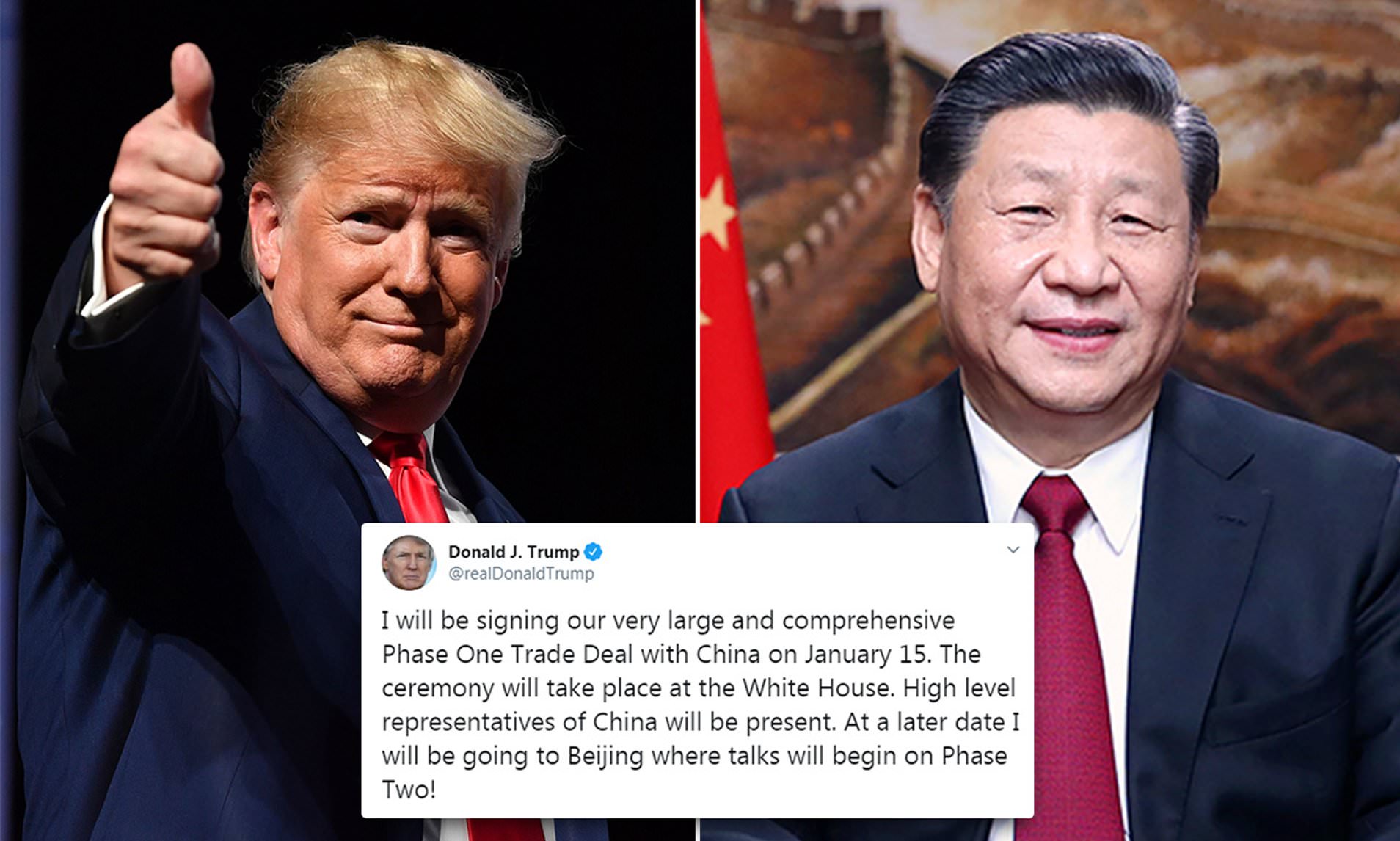
According to U.S. officials , China also pledged to increase its purchases of U.S. agricultural goods, energy, manufactured products and services by about $200 billion over the next two years. However, these amounts have not been confirmed by Beijing so far.
In exchange, Trump canceled plans to slap a 15 percent tariff on additional Chinese goods worth $160 billion, including laptops and smartphones. He also lowered duties on other goods worth $120 billion to 7.5 percent, (down from 15 percent). Yet he left a 25 percent tax on another $250 billion worth of goods.
U.S. officials had previously said that U.S. Trade Representative Lighthizer and Chinese Deputy Prime Minister Liu would sign the agreement on January’s first full week. The South China Morning Post reported on Monday that in anticipation of signing the deal next week, Liu would be coming to Washington this weekend.
The signing has not been confirmed by the White House, nor Lighthizer, and there has also not been any indication on the timeline of Trump visiting Beijing.
It remains unlikely that a more comprehensive two-phase agreement on issues such as Beijing’s support for state-owned businesses and government subsidy programs would be signed before the presidential election in November 2020, but both sides seem optimistic about further tariff reductions in the meanwhile.
In an interview on CNBC on Tuesday, White House trade advisor Peter Navarro said there were still “a lot” of outstanding issues to be addressed in the Phase Two deal, and probably in a Phase Three deal as well. This involves “cyber intrusions into our business networks and the wider problem of hacking,” as well as state-owned Chinese companies selling goods at unfairly low prices, he said.
According to Navarro, the phase one also includes a “very interesting” language to reduce China’s “horrible” trade in counterfeit goods, which are easily available to consumers over the internet.
“I’m going to be spending a lot of my time in 2020 making sure that when you go on e-commerce platforms like Amazon and Alibaba you don’t get stuck with counterfeits from China,” Navarro said.
He also mentioned that it could still take a while before the entire text of the phase one deal would be available as the 86-page document is being translated into Chinese.
By: J. Costa