A Heavyweight Arrives in Bucharest: What Washington’s New Number Two Signals for the US–Romania Relationship
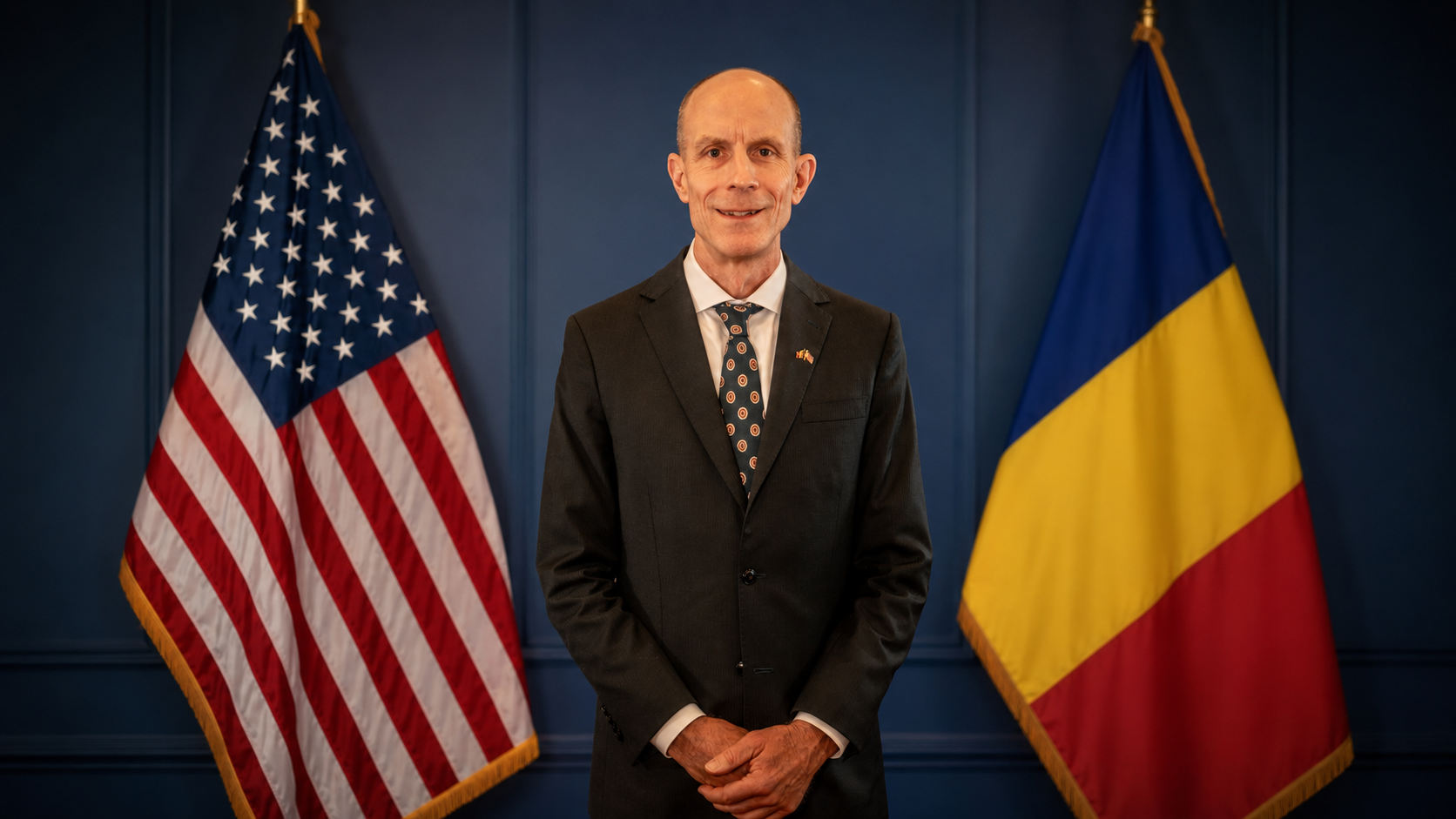
The résumé says everything the press release doesn’t. David Galbraith, the incoming Deputy Chief of Mission at the US Embassy, brings a career forged in conflict zones and crisis capitals to a frontline NATO state at the most dangerous moment in a generation. That choice is, we believe, a message.
Embassies announce new deputies all the time, and the notices tend to read the same way: a warm welcome, a nod to the “strong partnership,” a friendly detail about the newcomer learning the local language. The U.S. Embassy in Bucharest published exactly such a post this week to introduce David Galbraith as its new Deputy Chief of Mission, complete with the charming footnote that he studied Romanian before arriving and “liked it very much.”
Read past the warmth, though, and the announcement says something the pleasantries do not. It is not the arrival that is notable. It is the arriving officer’s curriculum vitae, and what it tells you about how Washington intends to run its Bucharest mission at this particular moment.
According to the embassy’s own account, Galbraith is a senior Foreign Service officer whose overseas assignments have taken him to Colombia, Myanmar, Venezuela, Iraq, Saudi Arabia and Egypt, alongside senior leadership roles back in Washington, including at the State Department and the National Security Council.
Pause on that list, because diplomatic postings are not interchangeable, and this is not the itinerary of a trade-and-culture diplomat. It is, almost item for item, a tour of the hardest security environments the United States has operated in this century. Colombia and the long war against narco-insurgency. Myanmar, an authoritarian state and a theatre of great-power competition with China. Venezuela, the object of a US pressure campaign and regime-change debate. Iraq, the defining conflict deployment of a generation of American officials. Saudi Arabia and Egypt, the twin anchors of US security policy in the Middle East. And then the National Security Council, the White House body where diplomacy, defense and intelligence are fused into strategy.
You do not assemble a career like that by accident, and a government does not deploy it by accident either. The Deputy Chief of Mission is the embassy’s second-in-command and, crucially, its chief operating officer: the person who runs the mission day to day, manages every section under one roof, and takes the helm as chargé d’affaires whenever the ambassador is absent. It is the post through which the machinery of an embassy is actually driven. Choosing to fill it with an officer whose formative experience is conflict, crisis and national security, rather than, say, commercial diplomacy or public affairs, is a choice about what kind of embassy Washington wants in Bucharest right now.
That choice arrives at Romania’s most consequential strategic moment since it joined NATO.
Romania is now a frontline state in the fullest sense. It shares a long border with Ukraine, hosts the Aegis Ashore missile-defense installation at Deveselu, and is home to the sprawling expansion of the Mihail Kogălniceanu air base on the Black Sea, set to become one of the largest NATO facilities in Europe. Russian drone debris has repeatedly fallen on Romanian soil. The war on the other side of the Prut and the Danube has escalated through the summer rather than wound down, even as diplomacy stalls in Manila, Geneva and back channels that lead nowhere. And the Black Sea, on which Romania sits, has become one of the most militarily contested bodies of water on the planet.
Into that environment Washington sends a number two whose entire professional life has been about operating where security is the organizing principle of everything else. The embassy’s post placed him explicitly in that frame, noting that he joins “at a moment when the partnership between the US and Romania continues to strengthen,” under Ambassador Nirenberg. The subtext is not hard to read: this is a relationship Washington increasingly views through a security lens, and it has staffed its embassy accordingly.
None of this is exotic or hidden; it is how great powers calibrate their missions, in plain sight, through personnel. But the practical implications for the US–Romania relationship are real, and Romanian officials, businesses and observers would do well to anticipate them.
An embassy weighted toward hard security tends to prioritize differently. Expect the relationship’s center of gravity to sit more heavily on defense cooperation, Black Sea posture, critical infrastructure protection, energy security, and the screening of foreign, particularly Chinese and Russian, investment and influence. Expect a mission that is more attentive to how Romania manages its exposure to hostile states, more engaged on the resilience of ports, grids and supply chains, and more insistent that a frontline ally hold the line on the commitments, including the NATO spending trajectory set at the Ankara summit, that frontline status demands.
For a country that has spent two decades cultivating the American alliance as the cornerstone of its security, this is, on balance, a signal of seriousness rather than distance: Washington does not send its heaviest operators to relationships it takes lightly. But seriousness cuts both ways. A more security-minded embassy is also a more demanding partner, quicker to press, less content with declarations that are not matched by delivery. The era of the relationship as a comfortable given may be closing; the era of the relationship as an active, scrutinized, high-expectations partnership is opening.
It would be easy to over-read a single personnel announcement into a spy novel. What the public record supports is more useful: the United States has placed an unusually security-forged official in the operational driver’s seat of its Bucharest embassy, at the precise moment when Romania’s geography has made it indispensable and exposed in equal measure. That is a fact to be weighed.
The welcome post ended with a friendly promise that Galbraith looks forward to speaking Romanian with partners and friends across the country. He will have a great deal to talk to them about. The pleasantries are genuine; so is the message underneath them. There is a new operator running the day-to-day of the American mission in Bucharest, his background says security first, and the relationship he helps steer is entering a more serious, more demanding phase. Romania’s political and business class would be wise to read the CV as carefully as the caption.
The message, then, is larger than one diplomatic appointment. Washington is not merely reinforcing its presence in Bucharest; it is imposing a new level of strategic discipline on the relationship. The days of ceremonial partnership, vague assurances and commitments left half-delivered are drawing to a close. Romania is no longer being treated as a peripheral ally with room for ambiguity, but as a frontline state expected to perform like one.
In plain terms, there is a new sheriff in town. Order, accountability and execution are about to matter more than appearances. Galbraith’s arrival signals that the American mission will be watching more closely, pressing harder and expecting results across defense, infrastructure, energy, foreign influence and institutional resilience. The tone may remain diplomatic, but the operating principle will be unmistakable: security first, promises measured against delivery, and little patience for business as usual.
Things are not simply about to become more serious…they are about to change fundamentally! Romania’s political and business establishment should prepare accordingly.
Sources: U.S. Embassy Bucharest official announcement (August 2026); US Department of State on the role of the Deputy Chief of Mission; public reporting on Romania’s role as a NATO frontline state, the Deveselu and Mihail Kogălniceanu installations, and Black Sea security.
By TDA