A Deep Freeze in the East China Sea: How Japan and China Arrived at Their Worst Crisis in a Generation

It began with a single sentence, spoken in the Japanese parliament, that a prime minister did not strictly need to say. On November 7, 2025, answering a question from an opposition lawmaker, Japan’s new leader Sanae Takaichi told the Diet that a Chinese attack on Taiwan could constitute an “existential crisis” for Japan, one that might permit Tokyo to exercise collective self defense.
For the first time, a sitting Japanese prime minister had openly linked a Taiwan contingency to the possibility of Japanese military intervention. Nearly ten months later, that sentence has hardened into the deepest rupture in relations between Asia’s two largest economies in more than a decade, and what began as a diplomatic spat now looks less like a passing storm than the emergence of a dangerous new normal.
The speed of the collapse surprised even seasoned observers. Only weeks earlier, Takaichi, Japan’s first female prime minister, had met Xi Jinping and spoken of pursuing a mutually beneficial relationship and deepening personal ties, and Xi had described the two nations as important partners whose stable relations served the region.
That diplomatic warmth evaporated almost immediately. Beijing demanded a retraction. Takaichi, responding to repeated questions in the Diet, refused to withdraw the remarks, insisting they were consistent with Japan’s existing legal position. Neither leader has found a way to climb down since, and neither appears to want to. Taiwan, which sits at the core of Chinese nationalism and has become a foundation of the Communist Party’s legitimacy and of Xi’s own legacy, is not an issue on which Beijing bends.
What makes the current crisis different from the periodic flare ups that have long punctuated the relationship is that it has metastasized across every dimension of the relationship at once, diplomatic, economic, and military, and shows every sign of being structural rather than temporary. As Elli Katharina Pohlkamp of the European Council on Foreign Relations put it, what began as a diplomatic quarrel over Taiwan is spiraling into something structural. That is the essential point. This is not a weather event. It is a change of climate.
On the diplomatic front, the symbolism has been unusually pointed. Japan’s 2026 Diplomatic Bluebook, the foreign ministry’s flagship annual statement of policy, quietly dropped its traditional description of China as “one of Japan’s most important bilateral relationships,” downgrading it to the cooler formulation of “an important neighboring country.” In the grammar of diplomacy, where adjectives are calibrated to the milligram, this was a deliberate demotion, and Beijing read it as one.
Chinese officials have accused Tokyo of reviving the militarism of its imperial past, language calculated to wound in a region where the memory of Japanese occupation remains raw. When a knife wielding member of Japan’s Self Defense Forces broke into the Chinese embassy in Tokyo in March, Chinese state media seized on the incident as evidence of a “resurgence of militarist thinking,” folding a lone criminal act into a broader narrative of Japanese remilitarization.
It is on the economic battlefield, however, that China has brought its heaviest weapons to bear, and where the crisis has inflicted the most tangible pain. Beijing moved quickly to restrict the export of critical minerals, rare earth materials, and dual use items, targeting dozens of Japanese companies, including defense firms but also manufacturers working in dual use technologies. The leverage here is real and asymmetric. China controls close to 90 percent of the world’s rare earth refining capacity, and Japanese industry felt the squeeze almost at once.
Beijing paired the export controls with a battery of other economic instruments familiar from its coercion playbook: travel advisories urging Chinese citizens to avoid Japan, restrictions on group tourism that sent visitor numbers tumbling, and continued heavy restrictions on Japanese seafood imports. Chinese airlines offered refunds to customers cancelling trips to Japan. The tourism and consumer boycotts are designed to be felt in Japanese shopping districts and hotel ledgers, a form of pressure that translates a political grievance directly into economic loss.
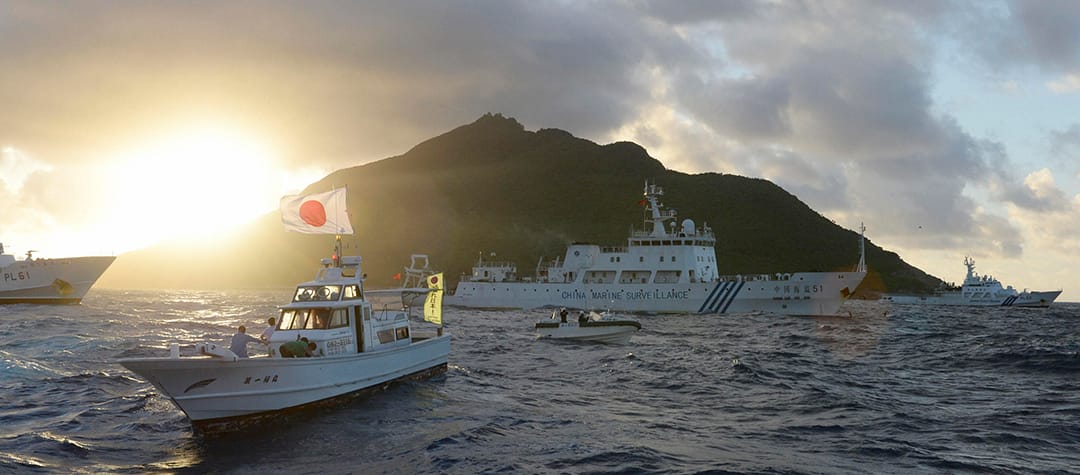 Dangerous aerial and naval encounters are rising as China and Japan spar over disputed islands in the East China Sea.
Yet the most consequential result of China’s economic pressure may be the opposite of what Beijing intended. Rather than bending Tokyo, the campaign appears to be accelerating precisely the trend China most fears: a Japan deliberately reducing its dependence on the Chinese market. Tokyo and Washington have moved to form joint action plans to secure alternative supply chains for critical minerals, and analysts increasingly describe Japan as gradually but decisively preparing for a future with reduced reliance on Beijing, reversing a decades long policy of courting its giant neighbor. The generation of pro Beijing “China hands” who once anchored the governing Liberal Democratic Party is aging out of politics, replaced by younger, more hawkish conservatives inclined to hedge against China and deepen ties with Taiwan. Takaichi herself, like her predecessor Ishiba Shigeru, visited Taiwan before taking office, almost as a rite of passage. The political center of gravity in Tokyo has shifted, and it is not shifting back.
The military dimension is where the danger becomes physical. China responded to Takaichi’s remarks with a show of force, including large scale drills in the waters and skies around Taiwan and Japan. Joint Russian and Chinese bomber patrols have flown near Japanese airspace, and increased Chinese naval activity through the Miyako and Osumi Straits, the maritime chokepoints that funnel traffic between the Pacific and the East China Sea, has kept Japanese air and naval forces on heightened alert. Japan, for its part, is not retreating. Its 2026 Defense White Paper highlighted Chinese short of war coercion and, tellingly, emphasized the deepening alignment among China, Russia and North Korea. Tokyo is pressing ahead with a defense buildup that includes the planned acquisition of some 400 US made Tomahawk cruise missiles, weapons whose range would allow them to strike targets within Chinese territory from launchers near Japan, and it recently conducted a missile test signaling its intent to integrate them despite delays in delivery. Each side’s defensive preparation reads to the other as provocation, the familiar and dangerous logic of a security spiral.
Amid the freeze, the thin threads of dialogue that remain are worth watching precisely because they are so thin. Senior officials from the two foreign ministries have met, and cross party delegations of Japanese lawmakers have traveled to Beijing in an effort to keep channels open and prevent a complete collapse of communication. These contacts have produced no breakthrough and were never likely to. But they matter as a floor, a shared if unstated recognition on both sides that a total severing of ties would serve no one, and that some mechanism must survive to manage a crisis that neither capital fully controls. In a relationship this large and this fraught, the absence of communication is itself a danger, and the modest lawmaker visits are, for now, a hedge against that danger.
Where this leaves the two countries is in an uneasy and possibly prolonged standoff. The structural forces driving the crisis, Chinese nationalism anchored on Taiwan, a more assertive and security conscious Japan, an American alliance drawing Tokyo closer, and the broader hardening of blocs across the Indo Pacific, are not the kind that resolve with a handshake or a carefully worded joint statement. Several analysts now speak of rough waters lasting another year or two at least, and of a new equilibrium that is more adversarial than anything the two neighbors have known in the post war era.
The economies of China and Japan remain enormously intertwined, which is the strongest brake on escalation and the reason a genuine rupture is unlikely. But interdependence did not prevent this crisis, and it has not resolved it. Asia’s two great powers have discovered that they can inflict real damage on each other without firing a shot, and having discovered it, they are unlikely to forget it. The freeze in the East China Sea will not thaw soon.
Sources: The Japan Times; Nikkei Asia; The Diplomat; TIME; Brookings; the American Enterprise Institute; the European Council on Foreign Relations; Japan’s 2026 Diplomatic Bluebook and 2026 Defense White Paper; Wikipedia on the 2025 to 2026 China Japan diplomatic crisis.
By I. Constantin