A Glacier Collapse Sends a Wall of Water Through Nepal and Tibet, Killing Hundreds – China Warns ‘High Risk’ of Barrier Lake Breaching its Banks

A slab of Himalayan ice and rock gave way high on the Nepal-China border and thundered down the valleys below, burying towns in mud, sweeping away bridges and hydropower stations, and leaving a toll that is still climbing three days later. Scientists say a warming planet helped set the mountain loose.
Today, China has warned there is a “high risk” that a lake which formed after the recent landslide may breach its banks, causing a second flood downstream. As of Friday, an estimated 2.5 million cubic metres of water had accumulated at the barrier lake near the Nepal-Tibet border, according to state broadcaster CCTV. Officials say that three million cubic metres of water is expected to flow into the lake between Thursday and the weekend, posing a “high risk of breach”.
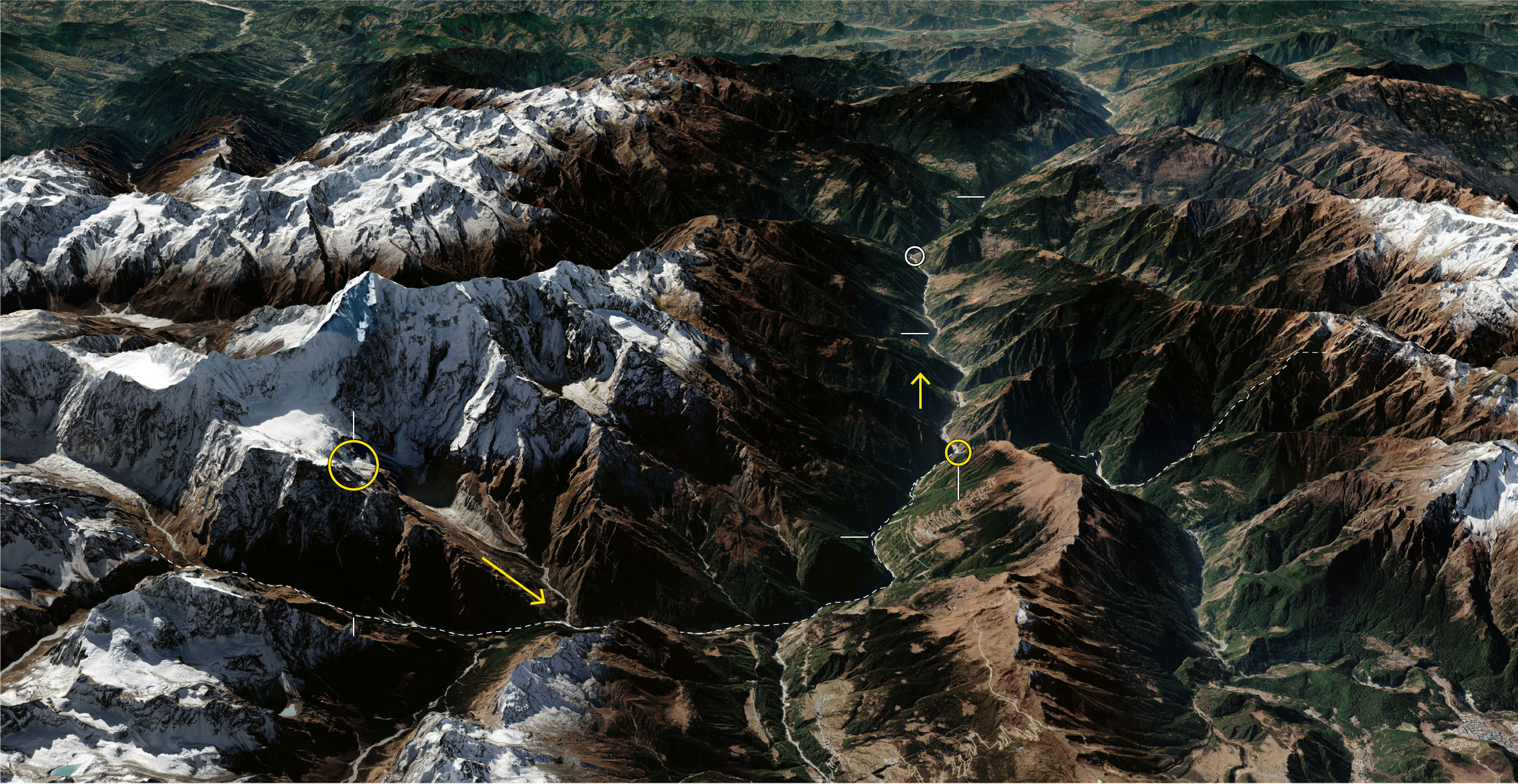
It began, as these catastrophes now do, without rain. On the morning of August 26, under clear skies high on the border between Nepal and China’s Tibet, a massive slab of glacier ice and rock detached from a mountain slope and crashed downward. The collapse was so violent that seismographs around the world registered it as the energy equivalent of a magnitude 5.2 earthquake, and geophysicists studying the event initially mistook it for one. It was not an earthquake. It was the mountain itself coming apart, and what followed was a wall of water, mud and debris that swept down the river valleys of Rasuwa and Nuwakot districts and across the border into Tibet, obliterating everything in its path.
Three days later, the scale of the disaster is still being counted, and the numbers keep rising. In Nepal, at least 389 people have been confirmed dead and more than 900 are missing, with police reporting the toll climbing toward and past 460 as rescuers reach areas that had been cut off. Across the border in Tibet’s Gyirong County, at least three more have died and 558 remain missing. In total, more than 1,500 people are unaccounted for across the two countries. Among the missing are hundreds of foreign nationals, more than 800 by some counts, including pilgrims who had travelled to the region for the sacred route to Mount Kailash. One couple from Texas, Deepak and Madhu Ahuja, had come to fulfil a bucket-list pilgrimage; their family has heard nothing since their last known location in Tibet.
The images emerging from the valleys are almost incomprehensible. Aerial views show entire settlements along the Trishuli River submerged not in water but in thick grey sludge, homes buried to their roofs, the landscape smoothed into an expanse of mud. In the town of Bidur, video captured people trapped on a balcony as a torrent of water and debris cascaded past below them. Twenty schools across three districts were damaged. Six major hydropower and transmission facilities were wrecked, cutting electricity across the region. Key bridges and highways, including the vital Gyirong Port trade crossing on the China-Nepal border, were destroyed, severing the very routes that rescuers now need to reach the survivors.
For the first crucial hours, no one was certain what had happened. With no rain falling and no storm in the forecast, officials wondered whether an earthquake had triggered the floods. It was the United States Geological Survey and independent scientists who pieced together the true sequence. Göran Ekström, a geophysicist at Columbia University’s Lamont-Doherty Earth Observatory, described a massive geophysical event high in the Himalayas: a landslide in a mountain pass that tore away a large chunk of land with glacial ice on top, sending millions of cubic metres of ice, rock and water cascading down as a highly mobile debris flow. The seismic signal the world’s instruments detected was not the cause of the flood but its consequence, the sound of a mountainside giving way.

Understanding why this keeps happening requires understanding the peculiar and growing danger of the world’s high mountains. A glacial collapse, as glaciologists describe it, is the gravity-driven detachment of a large mass of glacier ice from the slope it clings to, and it is closely related to the glacial lake outburst floods that have become a recurring nightmare across the Himalayas. As glaciers melt, they leave behind lakes of meltwater dammed by fragile natural barriers of ice and rock debris. When those barriers fail, or when a collapse sends ice and rock crashing into the water, the lake empties in an instant, unleashing a flood of staggering force on the valleys below. A study by the International Centre for Integrated Mountain Development and the United Nations Development Programme catalogued 3,624 glacial lakes across Nepal, India and Tibet, and classified 47 of them as potentially dangerous, 21 of those in Nepal alone. No forecast before the disaster had predicted an avalanche at this particular location.
This is the part that should trouble the wider world, because the mountain did not break at random. Scientists cited by Reuters and the BBC say climate change likely helped trigger the glacier’s collapse, and the reasoning is grim and simple. The Himalayas are warming faster than the global average, thawing the permafrost that has held mountain slopes together for millennia and swelling the glacial lakes that hang above populated valleys. A warmer atmosphere loosens the ice, destabilises the rock, and fills the reservoirs, loading the gun that gravity eventually fires. This disaster was not an isolated act of nature. It was the latest and deadliest in a rapid succession: glacial lake bursts struck Nepal’s Thame village in 2024 and its Humla and Rasuwa regions in 2025, and Sikkim in India in 2023, each a smaller rehearsal for the catastrophe now unfolding along the Trishuli. The frequency is not a coincidence. It is a trend.
The danger, moreover, is not over. Behind the landslide that started it all, a new lake has been forming in China’s Gyirong County, its water pooling against a natural dam of debris left by the collapse. Chinese authorities warned that this lake could burst, and the threat has at times forced rescuers to halt their search, the people trying to save the living driven back by the risk of a second flood. The region faces three more days of rain, raising the prospect of further landslides even as the first catastrophe is still being tallied. Rescue teams are contending with mountainous terrain, wrecked infrastructure, power outages and bad weather, an accumulation of obstacles that turns every hour of delay into a diminishing chance of finding survivors.
Behind the statistics are the specific, irreducible losses that no aggregate can capture. The pilgrims who came seeking the sacred and found catastrophe. The villagers who woke on an ordinary clear morning with no reason to fear the sky. The rescue workers, 28 police officers among the missing in Nepal, who went toward the danger. The families now watching phones that will not ring. More than 4,300 personnel have been deployed in Nepal alone, digging through mud that has become, in too many places, a grave.
What happened on the Nepal-Tibet border this week is a tragedy in its own right, complete and terrible. But it is also a warning written in ice and mud, legible to anyone willing to read it. The high mountains that billions depend on for water are becoming unstable as the planet warms, and the lakes and glaciers suspended above their valleys are turning into hazards that no seismograph can predict and no forecast can anticipate. The people of Rasuwa and Nuwakot and Gyirong paid the price this week for a warming that was decided far from their valleys. On current trends, they will not be the last. The mountain broke without warning, but the reasons it broke were not without warning at all.
By I. Constantin