Scroll Top

Intelligence Diplomacy in Cairo: Ratcliffe’s Visit Underscores a Quieter Path to Stability
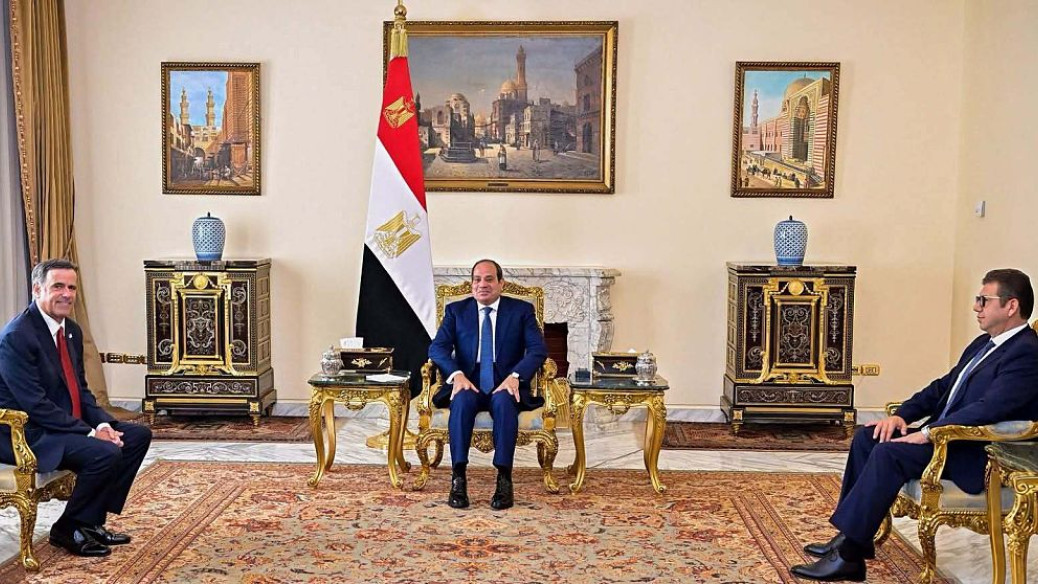
In a region often defined by sudden headlines and hard-edged military talk;  last Sunday’s meeting in Cairo felt like something rarer: a deliberate bet on conversation.
CIA Director John Ratcliffe sat down with Egyptian President Abdel Fattah al-Sisi in a visit that stood out not for spectacle, but for substance. Egypt’s intelligence chief, Hassan Rashad, joined the talks, a signal that this was not a courtesy call. It was working diplomacy of the kind that happens behind closed doors, then quietly shapes what happens next.
The agenda was as broad as the moment is tense. According to Sisi’s office, the two sides discussed the wars in Iran, the Gaza Strip and Sudan, as well as attacks on Gulf countries and threats to maritime security. That list alone captures how tightly the region’s crises now interlock. A spark in one theater can quickly become smoke in another.
Sisi used the meeting to restate a message Egypt has long tried to make the region’s North Star: crises are best settled through politics and diplomacy, not by letting them run. “The paramount importance of settling regional crises through political and diplomatic tracks,” the presidency said, was the president’s central point. It is a familiar Egyptian line, but it lands differently when spoken in the same week that Washington is warning of rapid escalation.
The backdrop is serious. The U.S. State Department has cautioned Americans against travel to the region as fighting between Saudi Arabia and Yemen’s Houthis intensifies. “This military conflict has the potential to escalate rapidly,” the warning said. Air and marine traffic has already been disrupted. Energy exports have been rattled. Global oil prices have climbed past $100 a barrel. In that climate, a high-level American intelligence visit to Cairo is more than a diplomatic footnote. It is a sign that Washington still sees Egypt as a place where hard problems can be talked through.


The timing reinforces that reading. Ratcliffe’s trip came only days after Saudi Crown Prince Mohammed bin Salman met Sisi in Cairo. The two leaders urged safe passage through Bab al-Mandab after the Houthis seized the Yemeni coast in a lightning offensive. Maritime security is not an abstract talking point. It is the artery of global trade, and Cairo has again placed itself at the center of efforts to keep that artery open.
Washington’s own recent choices also help explain why Cairo mattered this week. U.S. media reported that the United States declined a Saudi request to strike the Houthis. Soon after, the State Department approved a $24.3 billion sale of 48 F-35 fighter jets to the kingdom, describing the deal as a way to help Riyadh “deter current and future threats.” The pairing of restraint and reinforcement is classic alliance management: not every request is granted, but partners are not left without tools. Egypt, a key U.S. ally and one of the top recipients of American military aid, remains uniquely placed to interpret that balance to others in the region.
That is Egypt’s distinctive value. Cairo has spent years keeping lines open to rivals who barely speak to one another, including Israel, Hamas and Iran. In a landscape of broken channels, that is not a small thing. It is a form of power. Sisi’s office said Ratcliffe “lauded Egypt’s pivotal role in supporting efforts aimed at reaching peaceful, comprehensive settlements to regional crises.” Coming from the director of the CIA, that praise is not ceremonial. It is an acknowledgment that intelligence work, at its best, is not only about knowing the map. It is about keeping the map from catching fire.
There is a larger pattern here, and it is the one that matters most. Ratcliffe has recently stepped up intelligence diplomacy, treating relationships with trusted partners as instruments of de-escalation rather than mere collection points. The Cairo meeting fits that shift. It suggests a CIA director who is using access, timing and personal engagement to support political off-ramps while the region is still capable of taking them.
None of this magically ends the wars that brought him there. But it does something important in a dangerous week: it puts experienced hands in the same room, in a capital that still talks to almost everyone, and it does so with a public emphasis on peaceful settlement. In the Middle East, that kind of visit is not a sideshow. It is often how worse outcomes are avoided.
If Ratcliffe’s Cairo stop is a sign of things to come, then the United States is not only watching the region’s crises. It is investing in the people and partnerships most able to contain them. That is a positive story in a hard season, and it is one worth watching. 
By Ovidiu Stanica

Related Posts