The Venice of the East, Underwater: Bangkok Declared a Disaster Zone as Record Rain Submerges the City
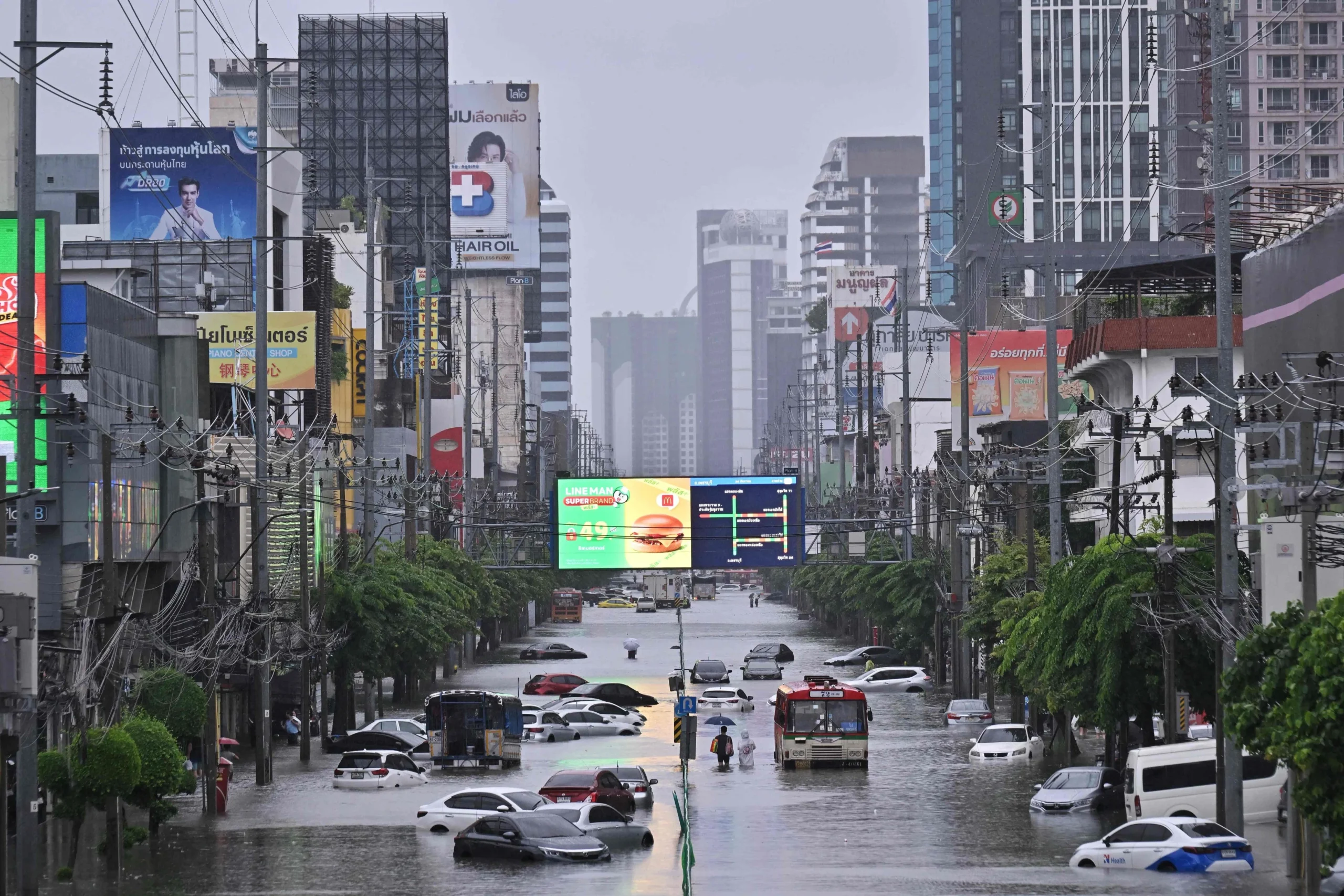
Bangkok woke on Saturday to find itself a disaster zone. After nearly two days of relentless rain, the governor of the Thai capital declared the city a disaster-affected area on September 26, as floodwaters swallowed major roads, submerged cars, and forced residents to wade through water that in places reached the waist and, elsewhere, the chest. Nearly 300 millimetres of rain, about twelve inches, fell within 48 hours, an extraordinary deluge that overwhelmed the drainage of one of Southeast Asia’s largest cities and turned its streets into rivers. Governor Chadchart Sittipunt warned bluntly that the crisis “poses a risk to people’s lives” and threatened both public and private property, with the flooding most severe near the city’s network of canals.
The scale of the emergency became clear as the day wore on. By some accounts, all fifty of Bangkok’s districts were declared flood disaster zones, with at least thirteen major roads submerged and traffic blocked at dozens of locations across the metropolis. Images from the city showed the now-familiar and still-shocking scenes of urban flooding: abandoned vehicles half-submerged on Phetchaburi Road, residents carrying luggage from condominiums ringed by brown water, shopkeepers bailing out inundated stores, a man pushing through chest-high water in the Bang Bua district. The Bangkok Metropolitan Administration said its pumping stations were running at full capacity, moving roughly 1,200 cubic metres of water per second, and estimated it would take two to three days to drain the city once the rain finally stopped.
The government’s response reflected the gravity of the situation. The Thai army began setting up shelters and field kitchens, schools were designated as temporary accommodation, and by Saturday shelters had been opened for around 980 people. Authorities urged residents to avoid unnecessary travel, and Prime Minister Anutin Charnvirakul cut short a trip to London to return and manage the crisis. The city’s public transport authority offered free access to its metro “park and ride” carparks so residents could move their vehicles to higher ground until October 2, and an emergency advisory urged those living near canals to lift their possessions above the rising water. Supermarkets filled with people stocking up on supplies, a sign of a population bracing for days of disruption.
The human texture of the disaster came through in the voices of ordinary residents caught unprepared. “I wasn’t aware enough to consider relocating” before the warning came, said Suppakarn Julavijitphong, carrying luggage from a condominium surrounded by floodwater. A teenage resident, Sansuk Laowatcharakul, described facing the crisis alone: “I’m worried too, because I haven’t stocked up on food beforehand, and I’ve never faced this kind of situation alone before, since my parents aren’t with me.” Their words capture something important about urban flooding, that it arrives not as a distant statistic but as a sudden, intimate upheaval of daily life, stranding people in their homes and severing the ordinary rhythms of a working city.

To understand why Bangkok is so acutely vulnerable, one has to understand what the city physically is. Once known as the “Venice of the East” for its canals, Bangkok is built on former marshland and sits only about 1.5 metres, roughly five feet, above sea level. It is, in effect, a vast low-lying floodplain that has been paved over and built up into a megacity of more than ten million people. That geography makes it exceptionally prone to flooding: rainwater has few natural places to go, the canals that once drained the marsh can quickly overflow, and the sheer density of concrete prevents the ground from absorbing the deluge. When 300 millimetres of rain falls in two days, a city so close to sea level and so thoroughly built over has limited capacity to shed it, and the water simply rises.
This latest disaster does not stand alone, and its context is sobering. Thailand endured its worst floods in decades in November, when catastrophic rainfall in the country’s southern provinces killed at least 145 people, with some rescue-worker estimates of the toll in the hardest-hit areas running far higher, damaged thousands of homes, and caused economic losses estimated in the billions of dollars. That the country now faces another major flood emergency, this time in its capital and economic heart, within a year points to a pattern that Thai authorities and citizens alike are being forced to confront. The Department of Disaster Prevention and Mitigation has warned of continued low pressure across eastern, northeastern and central Thailand, raising the risk of flash floods, forest runoff, mudslides and river overflow beyond Bangkok itself.
It would be premature to attribute any single weather event solely to climate change, and responsible reporting resists that simplification. But the broader trend is difficult to ignore. Warming raises the amount of moisture the atmosphere can hold, and a hotter atmosphere tends to produce more intense bursts of rainfall, the kind of concentrated deluge that overwhelms drainage systems designed for gentler patterns. Low-lying coastal megacities like Bangkok sit at the intersection of several compounding risks: heavier downpours from above, rising seas from below, and land that in some areas is slowly sinking as groundwater is extracted. None of these forces caused this particular flood on its own, but together they describe a future in which such events become more frequent and more severe, and in which a city built a metre and a half above the sea faces an increasingly precarious relationship with the water all around it.
For now, the immediate priority is getting through the emergency. The rain, forecasters warned, could continue through the weekend, and the governor cautioned that while the flooding should recede once the downpours subside, the draining would take days. The city’s main international airport, Suvarnabhumi, continued operating normally, though the tourism authority advised travellers to allow extra time, a reminder that Bangkok is also one of the world’s most visited cities, and that a disaster in its streets ripples outward into the region’s economy and the plans of millions of visitors. Municipal workers in bright orange raincoats worked through the rain to keep debris from clogging the drains, one of them, Kwan Nobnom, offering a small and telling observation: “We thought this year would be dry.”
That expectation, that this year would be dry, may be the most quietly revealing line to emerge from the disaster. It speaks to a assumption, common to cities everywhere, that the climate of the past is a reliable guide to the climate of the present. Bangkok’s flood is a reminder that this assumption is fraying. A great city, home to more than ten million people and one of Asia’s cultural and economic capitals, spent a weekend under water, its residents wading to safety and its army cooking meals in shelters. The water will drain, the roads will reopen, and life will resume. But the deeper question the flood poses, how a low-lying megacity adapts to a wetter, more volatile future, will not drain away with the rain. It will return, as the water did, the next time the sky opens over the Venice of the East.
By I. Constantin