Scroll Top

EPLO is debating: The Role of AI in Advancing Human Rights and Multilateral Diplomacy
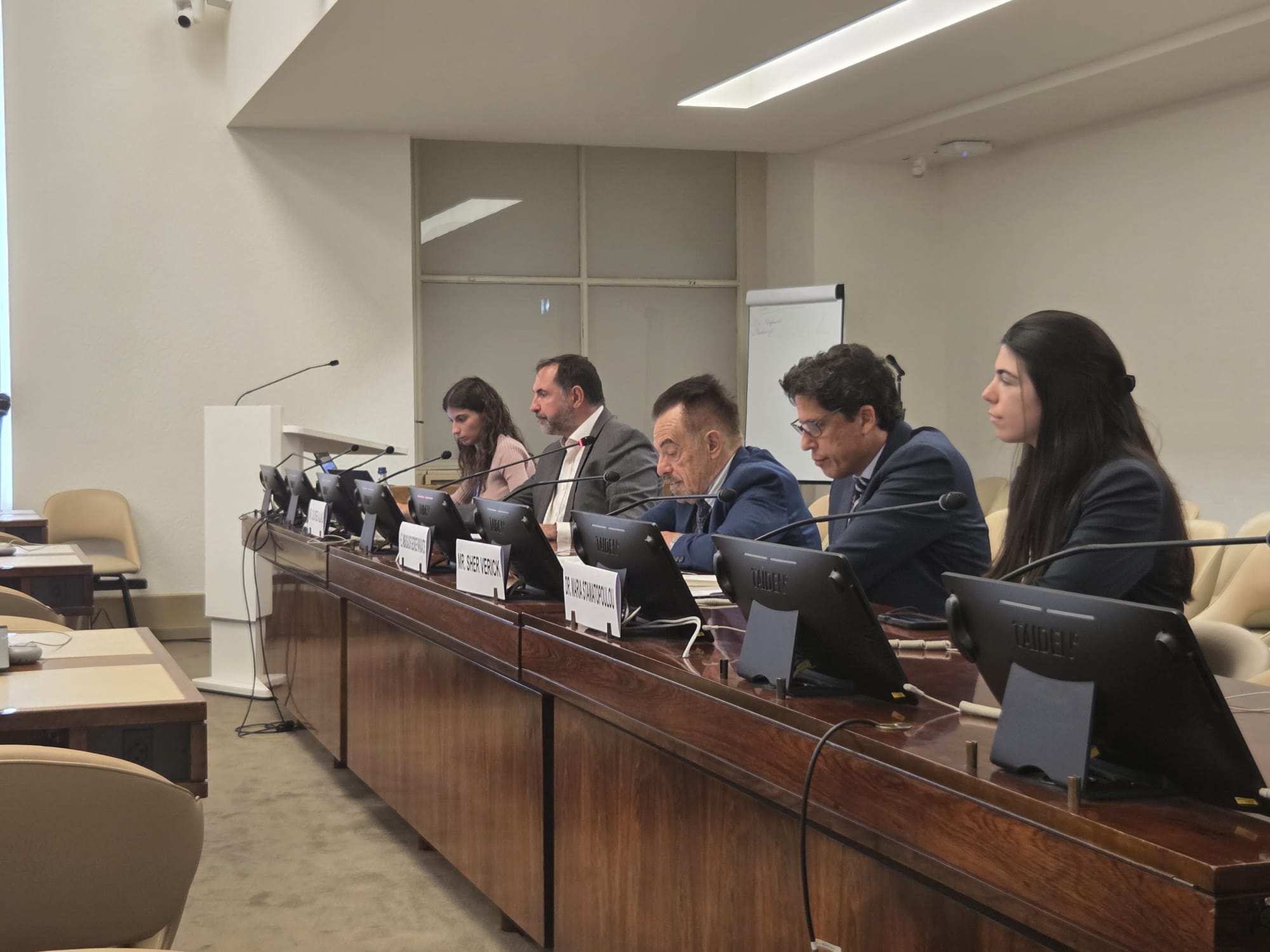
On a Monday morning in Geneva, with the Palais des Nations behind them and a season of stalled talks all around, the European Public Law Organization asked a question that diplomacy has been circling for years: can artificial intelligence help restore collective action when politics itself has gone rigid?
The side event, held at UN Geneva on 28 September 2026, did not treat AI as a new sovereign or a clever substitute for judgment. It treated it as something more modest and, in the present climate, more useful: a way of organizing complexity when conventional methods reach an impasse. Geopolitical fragmentation, institutional paralysis and a visible loss of confidence in multilateralism framed the discussion. The panel mixed diplomacy, the world of work, technical standardization and the private technology sector, and the disagreement that mattered was not whether machines should negotiate. It was where the human hand must remain on the process.
Ambassador George Papadatos gave that boundary a name. He called it the last mile of diplomacy: a human, AI and, eventually, quantum-assisted architecture in which the parties begin not with outputs but with constraints. Applicable law. Human-rights limit. Political red lines. Security requirements. Humanitarian priorities. Acceptable risks. Only after those are defined would computation map the negotiating space and generate possible configurations. States and negotiators would keep legitimacy, accountability and the final decision. The image is less of a diplomat replaced than of a corridor cleared. AI does not choose the destination. It shows which paths are still open once the non-negotiables have been stated in terms a system can actually use.
That sequencing is the idea’s real content. Too often, computational tools are invited in after positions have hardened, asked to “find a compromise” inside a space no one has properly described. Papadatos reversed the order. Law and rights come first, as design conditions rather than as a footnote to an optimized deal. In a period when human-rights language is easily treated as rhetoric that yields to urgency, the architecture he sketched does something quieter: it makes those constraints operational before any scenario is run.
The rest of the panel broadly accepted AI as a complementary analytical instrument and then spent its time on what that phrase cannot be allowed to hide. Present-day large language models, speakers argued matter more immediately than quantum computing. The glamour of a future machine is a poor excuse for neglecting the tools already on the table. What decides whether those tools help or harm is not raw capability? It is problem specification, data quality, standards, human oversight and responsibility. A model that hallucinates a legal obligation or that has been trained on a negotiating history written by the powerful, does not become safe because a human signs the communiqué at the end.
From the International Labour Organization came a reminder that multilateralism is not only a conversation among capitals. AI-assisted negotiation, if it is to mean anything beyond elite process management, has to connect to social dialogue, decent work and the participation of workers. A configuration that looks elegant to foreign ministries and intolerable to the people who will live under it is not a diplomatic success. It is a deferred crisis. The point lands especially hard in Geneva, where labour standards and human rights have long been argued in adjoining rooms and too rarely designed into the same system.
The International Telecommunication Union’s contribution pushed the governance question one step further. Technical standards already function as a form of rule-making. They decide interoperability, access and, increasingly, whose values travel inside the infrastructure. The warning was plain: public-interest safeguards cannot be left to private contracts or to corporate discretion. If the tools that map a peace process, a trade negotiation or a humanitarian corridor are governed only by the terms of a vendor agreement, then the multilateral system has outsourced a piece of its authority without admitting it. Standards, in this telling, are not a technical afterthought. They are one of the few places where accountability can be written down before a crisis arrives.
Dr. Maria Stamatopoulou drew the line the whole event kept returning to. Machines can perform tasks. They cannot legitimately make certain judgments. Sorting positions, surfacing overlooked trade-offs, testing scenarios, exposing inconsistencies between a stated red line and a proposed text: these are tasks. Deciding whose suffering counts, which risk a society may accept, when a compromise betrays a right rather than balances an interest: these are judgments. Confusing the two is how assistance becomes authority.
Participants did not let the distinction stay abstract. They pressed on bias, on hallucinations, on accountability when a recommendation cannot be traced, on the limits of what a machine can know about a room it has never sat in. Diplomacy’s informal dimension survived the morning intact. The corridor conversation, the confidence that is not minuted, the relationship that makes a text movable when the text itself is stuck: none of that is a dataset. An architecture that cannot see it will systematically undervalue the very thing that has historically closed the last mile.
What emerged was not a programme and not a product. It was a discipline. Use computation to widen the visible negotiating space. Do not use it to launder political choice. Specify the problem before inviting the model. Treat human rights as constraints on the search, not as language to be added once a deal is found. Keep standards public where the interest is public. Leave the judgment, and the responsibility for it, with people who can be answered to.
In a year when collective action is easier to doubt than to practice, that is a modest claim. It is also the only one that fits the institution the event was held in. Multilateral diplomacy does not need a machine that promises to end impasse. It needs instruments that make renewed, human-led negotiation possible when the old methods have run out of road, and rules strong enough to stop those instruments from quietly choosing the road themselves. 
By Paul Bumman

Related Posts