The MAGA Movement Is Officially Dead! Blue Wave Sweeps Democrats into Power, Winning Both the House and the Senate
Democrats flipped both chambers of Congress and swept across Republican turf on Tuesday, handing Donald Trump the heaviest midterm rebuke of the modern era. The result is more than a bad night. It is the electorate dismantling, piece by piece, the coalition that carried him back to power.
For a decade, the American right has met every prediction of its demise with the same answer: the experts said MAGA was finished in 2017, after Charlottesville; in 2020, after the election defeat; in 2021, after the Capitol riot; in 2023, after the indictments. Each time the movement came back stronger, and each premature obituary became a trophy on the wall. This is the honest context in which any new death notice has to be written.
And yet the results of Tuesday’s midterm elections are difficult to read any other way. Democrats did not simply win. They flipped both the House of Representatives and the Senate, won across territory that was supposed to be permanently out of reach, and recorded what analysts described as the largest House popular-vote margin for either party since 1974. They were on course to hold a majority of the nation’s governorships for the first time since 2011. Whatever one calls the thing that happened, it was not a normal midterm correction. It was a repudiation.
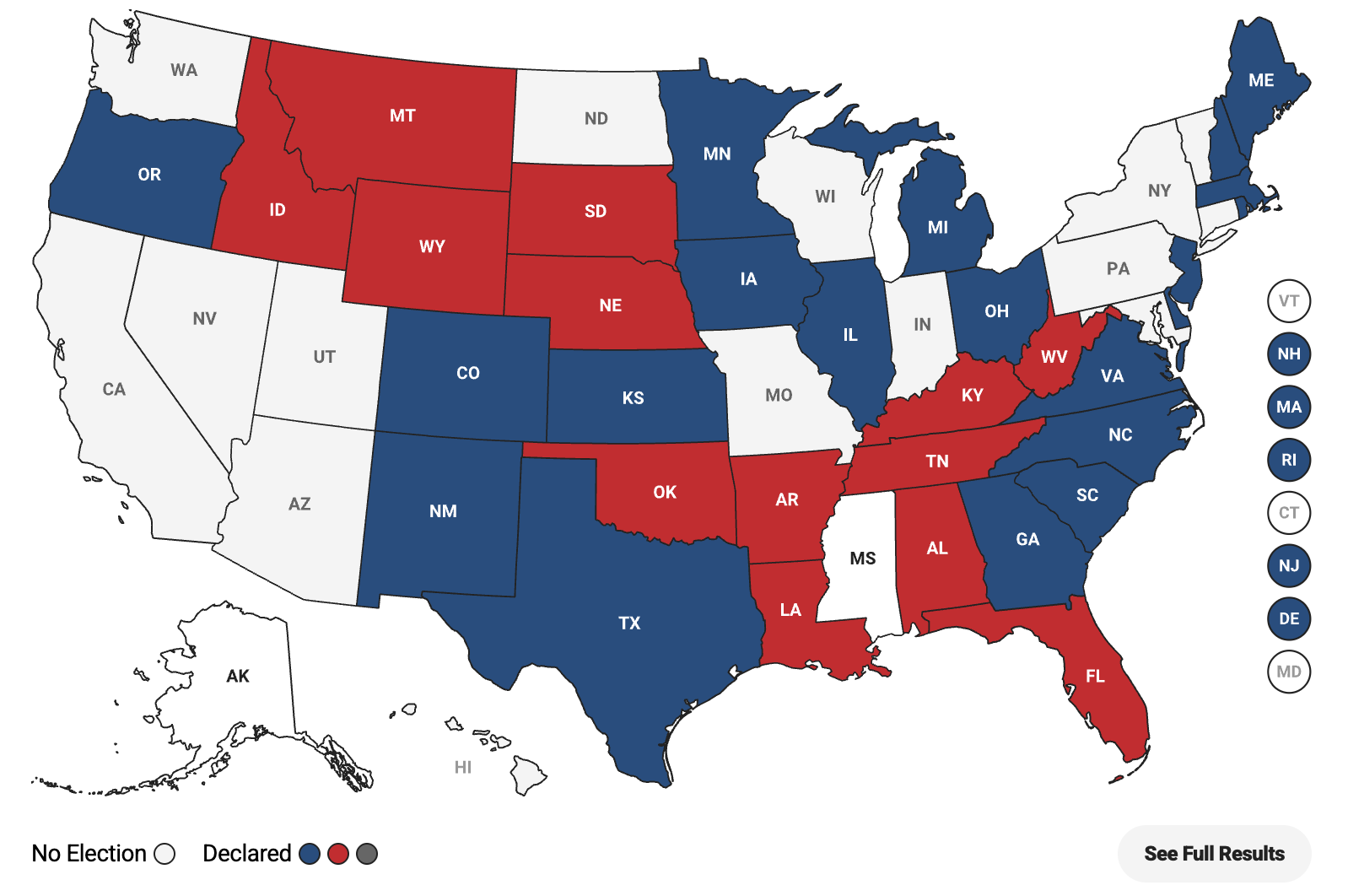
The numbers tell the story before any interpretation is layered on top. The president’s party loses ground in almost every midterm; the postwar average is around 26 House seats, and both parties have suffered far worse, Democrats losing 64 seats in 2010, Republicans 42 in 2018. By the early hours of Wednesday, Democrats were projected to gain more than three dozen House seats and a clutch of Senate seats well beyond the handful they needed, according to projections from major American broadcasters.
The map was the shock. In Texas, a state no Democrat had won a Senate seat in since 1988, the party broke through, a result built in part on the corruption cloud and the 2023 impeachment that trailed the Republican candidate, Attorney General Ken Paxton. Roy Cooper carried a Senate seat in North Carolina. In Georgia, where Jon Ossoff held his seat, voters also elected Keisha Lance Bottoms, making her the first Black woman elected governor in American history. Michigan appeared poised to send Abdul El-Sayed to Washington as the first Muslim member of the Senate. Counties that had voted for Trump a year earlier swung left by double digits. Republican-drawn districts in Florida, engineered to be safe, fell anyway.
Several races were still being counted as this piece went to press, and the final totals will take days to settle. But the direction was unmistakable the moment the first results landed, and nothing that followed reversed it.
Movements do not collapse over abstractions, but they do collapse over prices. The single most important finding of the night was also the most mundane: roughly nine in ten voters called the cost of living a crucial or major factor in their vote, and a similar share said they were worried about the price of petrol and groceries. Nearly two-thirds said Trump’s policies, above all his tariffs, had made the economy worse rather than better.
This is the exact inversion of the bargain that returned Trump to the White House. In 2024 he won on a promise to crush inflation and make daily life affordable again. Affordability was his sword. By 2026 it had become the blade turned against him. The tariffs that were sold as a weapon against foreign competitors were experienced by American households as higher prices, and the voters who had given him the benefit of the doubt took it back.
Two other grievances compounded the economic one. Nearly two-thirds of voters said the decision to go to war with Iran, a conflict still unresolved on election day, had been wrong. And the aggressive immigration raids that the administration treated as a signature achievement read, to a decisive slice of the country, as cruelty without competence. The combination, expensive groceries, an open-ended war, and scenes of enforcement that unsettled even sympathetic voters, proved toxic.
The most dangerous number for the American right is not any single seat. It is the sound of the 2024 coalition cracking. Independents, who had split almost evenly between the parties two years ago, broke for Democrats by around 17 points. That swing alone is enough to end most majorities. Worse for Republicans, the gains Trump had made among Latino voters, gains that were supposed to herald a lasting realignment, substantially reversed: Democrats won roughly 65 percent of the Latino vote, up sharply from 2024, with the recovery visible everywhere from Virginia and New Jersey to Texas and Florida. Trump’s own job approval stood near 38 percent, with 62 percent disapproving, among the weakest readings for any modern president heading into a midterm.
A movement can survive losing its opponents. It cannot survive losing the people it had just persuaded. The suburban independents and the working-class Latino voters who made 2024 a realignment rather than a squeaker were the ones who walked away in 2026.
So why call it death rather than defeat? Because of what the defeat was made of. This was not a story of Democrats inspiring the country. By most accounts the winning party ran a disciplined, almost boring campaign about prices and competence. It was a story of the MAGA project failing on its own chosen terms. It promised affordability and delivered inflation. It promised strength and delivered a war most Americans did not want. It promised to drain a corrupt establishment and then ran candidates, hand-picked in Trump-dominated primaries, whose own baggage sank them in states that should have been safe. The brand did not merely lose an argument. It failed the test it set for itself, in front of the voters it had convinced.
Intellectual honesty requires the other half of the ledger, and it is not trivial. Midterms punish the party in power almost as a law of nature, and a backlash of this size, while historic, is a difference of degree. Trump himself was not on the ballot, and a movement organised around one man is notoriously hard to kill while that man still commands his party’s machinery and its primary voters. The same obituary has been written many times and been wrong every time. The presidency is not up until 2028, the Democratic coalition that won on Tuesday is a fragile alliance of its own, and off-year verdicts have a way of looking smaller in hindsight than they did on election night. A party that has just been humiliated often reinvents itself faster than its triumphant opponents expect.
All of that is true. It is also beside the central point. Even if MAGA as an organisation survives, MAGA as the country’s governing majority, the thing that could win elections rather than merely contest them, is what voters dismantled this week. Movements do not usually die in a single evening. But they do receive, on particular nights, a verdict they cannot talk their way out of. This was one of those nights, and the American right will spend the next two years arguing about whether it was a defeat to recover from or a funeral it refuses to attend.
By I. Constantin