The Salt Beneath the Sovereignty: Latin America Turned Right, and the World’s Lithium Hangs in the Balance

Beneath the blinding white expanse of the Salar de Uyuni, the largest salt flat on earth, lies a prize the clean-energy age cannot do without, and a political question Bolivia has spent two decades failing to answer. The flats stretch across ten thousand square kilometers of southwestern Bolivia, so vast and so uniformly white that they are visible from the International Space Station and used to calibrate Earth-observation satellites.
Beneath their eight-meter crust sits some of the largest lithium reserves on the planet. Together with Argentina and Chile, Bolivia forms the “lithium triangle,” which holds well over half of the world’s known supply of the metal at the heart of every electric-vehicle battery and grid-storage system.
For years the defining tension across this region has been between two impulses: the desire to keep a strategic national resource under state control, and the need for the foreign capital and technology required to get it out of the ground. Now a wave of elections has swung the region’s politics rightward, and the terms on which the world’s batteries will be filled are being rewritten in La Paz and Santiago.
The most dramatic turn came in Bolivia, the country that sits atop the richest reserves and has done the least with them. In its salt flats Bolivia holds an estimated 23 million tonnes of lithium, double the resources of neighboring Chile, and yet it remains the only member of the triangle that the US Geological Survey still does not consider commercially viable.
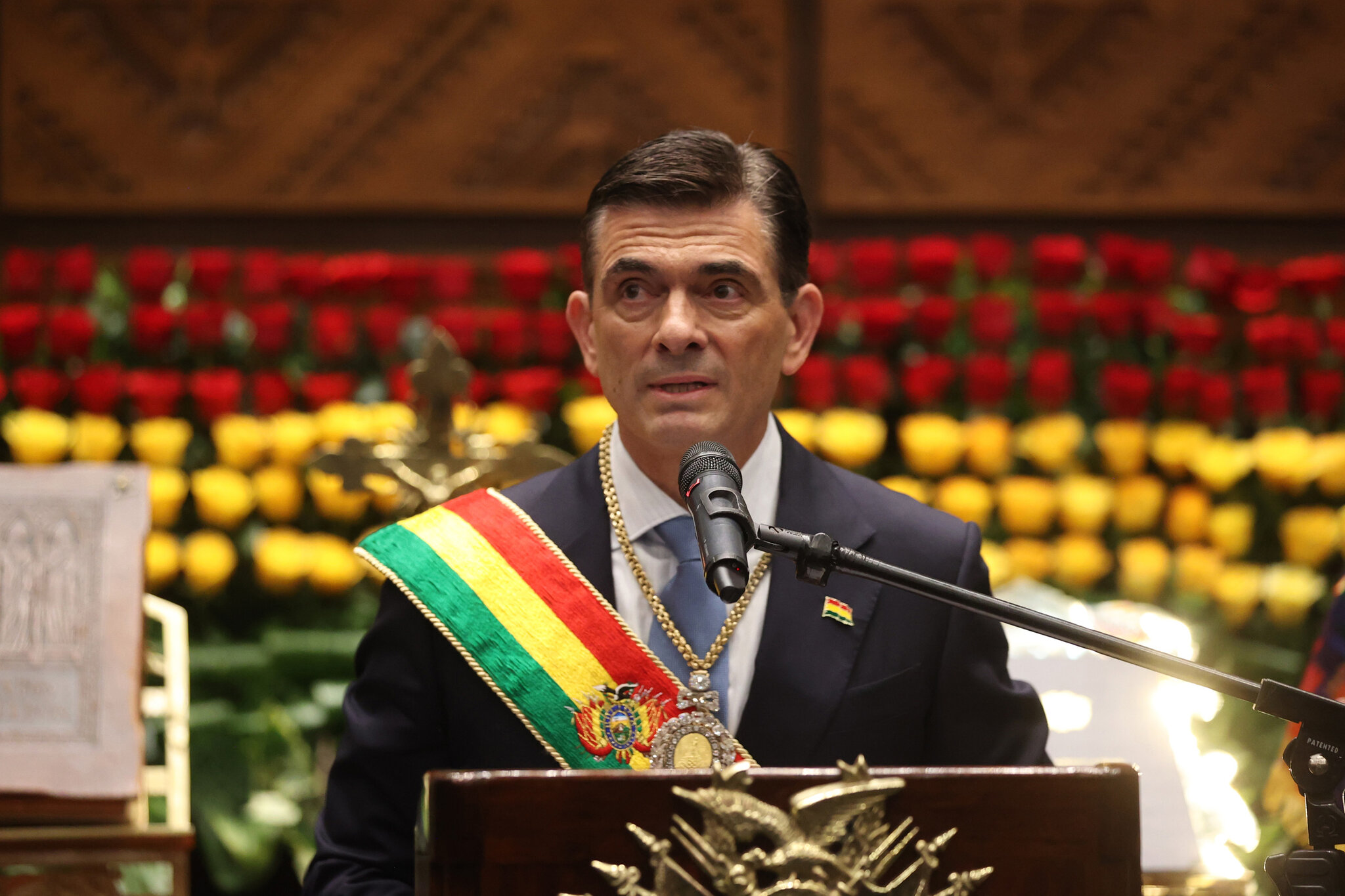 Bolivian President Rodrigo Paz took office on 8 November 2025. Photo by Luis Gandarillas/Pool/Bloomberg via Getty Images.
In October 2025, voters ended almost twenty years of rule by the leftist Movimiento al Socialismo, electing the centrist Rodrigo Paz, who took office on November 8 promising private-sector-led growth, a decentralized government and foreign direct investment. The result was a repudiation not only of a party but of a development model, and of the economic wreckage it left behind. Under successive MAS governments, inflation climbed above 20 percent in 2025, its highest level in nearly four decades, and Bolivians endured widespread food and fuel shortages worsened by political infighting and protest blockades. For a country in that condition, the lithium beneath the Salar looks less like a symbol than a lifeline.
The difficulty is that in Bolivia it is both, and this is the knot Paz must somehow untie. Protection of the Salar de Uyuni is not merely policy but national identity, a cherished emblem of sovereignty and indigenous heritage. It is written into the constitution itself, which stipulates that only the state may extract lithium. Changing that would require a referendum or constitutional reform, a step Paz has not yet dared to take, and which analysts doubt he has the political power to force through quickly.
Federico Gaston Gay, principal lithium analyst at Benchmark Mineral Intelligence, expects no swift rewriting of the law, suggesting instead that the government may pursue a short-term program of exceptions to bypass the restriction for a time. Paz, wary of alienating the still-potent base of the MAS and its founder Evo Morales, has vowed not to “sell out” the salt flats even as he tries to open them.
His dilemma runs deeper than the domestic politics, into the geopolitics of the contracts he inherited. The outgoing government of Luis Arce had bet on new direct-extraction techniques and, in 2024, signed deals with a unit of China’s battery giant CATL and with Russia’s state-owned Uranium One to develop projects using that method. Neither is close to commercial production, and both now face congressional scrutiny, with Paz’s administration reviewing what observers describe as an array of opaque lithium contracts with Chinese and Russian firms. Here is the paradox at the center of his presidency: he wants to draw in Western capital and reduce Bolivia’s dependence on Beijing and Moscow, yet the existing agreements are precisely with Chinese and Russian companies, and unwinding them risks both legal entanglement and the loss of the only investors who actually turned up. His government has categorically denied any intention to privatize the state lithium company YLB, even while admitting its mounting debts, and has signaled a preference instead for public-private partnerships. Bolivia’s foreign minister travelled to Washington last month to explore US financing, and reportedly floated the idea of a currency swap similar to the one the United States extended to Argentina.
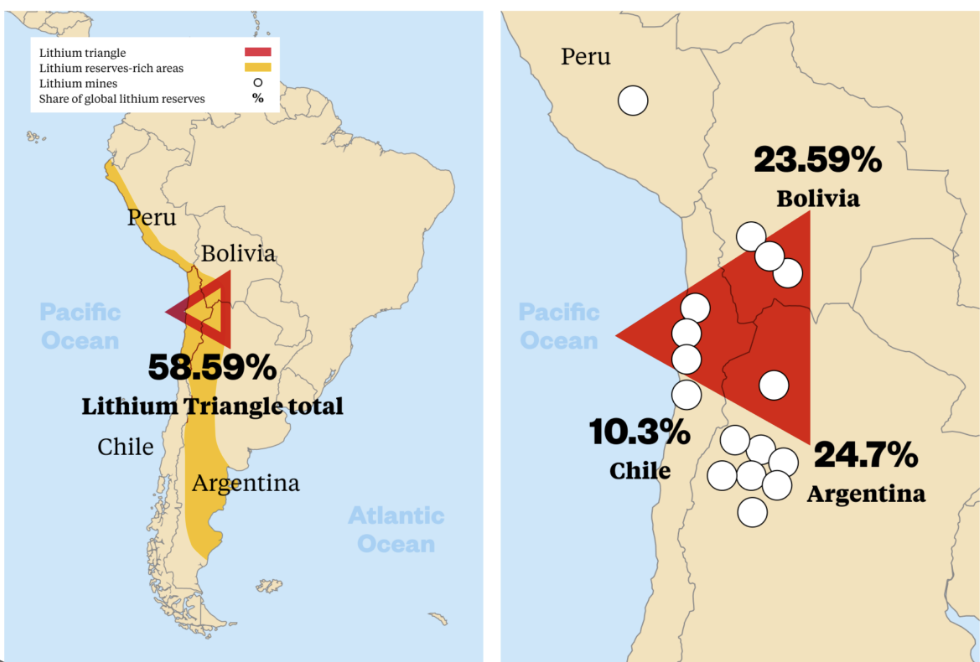 The Lithium Triangle (Chile, Argentina, and Bolivia) and global lithium reserves (2022)
The obstacles are not only political and diplomatic, but also physical. Bolivia’s geography is unforgiving: the nearest port to the landlocked Salar lies more than four hundred kilometers away, in Chile, and the high magnesium content of Bolivian brine makes extraction more expensive than in the neighboring deposits. Infrastructure remains largely undeveloped.
And the one concrete legal step Paz has taken to signal his pro-investment turn, Supreme Decree 5503, which scraps fuel subsidies and offers a fifteen-year fiscal-stability window and lower taxes for strategic sectors including mining, has provoked exactly the backlash that makes Bolivia so daunting to investors. The decree pushes petrol prices up by roughly 80 percent and diesel by about 160 percent, and it has been met with nationwide strikes led by the trade unions and mining cooperatives that dominate the country’s artisanal sector.
Paz has been forced to negotiate, striking a deal in December 2025 to amend the law to allow joint ventures between cooperatives and private companies. The turbulence is its own deterrent. Analysts note there is genuine appetite to invest in Bolivia, but that companies will want guarantees, something akin to Argentina’s investment-incentive regime, before committing capital to so volatile a landscape.
Chile, the triangle’s established producer, has undergone its own rightward swing, and the contrast is instructive. In December 2025 the country elected the far-right José Antonio Kast on a platform of economic growth and liberalization, and he inherits something Paz can only envy: a mature, globally integrated lithium industry, the world’s second-largest producer after Australia, well known to foreign investors.
But Chile too has left much of its vast reserve untapped, and Kast inherits a policy in flux. His leftist predecessor, Gabriel Boric, had moved to expand state control, giving the copper giant Codelco a central role in new projects through a public-private framework designed to capture more of the resource’s value for the nation. How aggressively a market-friendly Kast reshapes that arrangement, and whether Santiago returns to international markets to court investment after the election, as analysts expect it will, will shape global supply as much as anything happening in Bolivia. For investors weighing Argentine, Bolivian or Chilean white gold, Chile remains the more alluring bet, with Argentina’s fully liberalized sector the safest of all.
Step back, and a regional pattern comes into focus that complicates the easy story of a simple swing from left to right. The deeper truth is that resource nationalism in the lithium triangle is not so much being abandoned as renegotiated. Bolivia’s outgoing left built a state-monopoly model that failed to deliver; Chile’s outgoing left moved to increase state control of a functioning industry; and the incoming governments of the right in both countries now face the same underlying dilemma their predecessors did. They must reconcile the political imperative that a strategic national asset be seen to benefit the nation with the hard reality that lithium is capital-intensive, technologically demanding, and dependent on foreign expertise. The names and the ideologies change. The equation does not.
Hovering over all of it is the contest between great powers. China, through CATL and other firms, has moved aggressively into the region and now dominates much of the global lithium supply chain and refining capacity. The elections have introduced real uncertainty into that position: two new governments, both more sympathetic to Western capital, both reviewing deals struck with Chinese and Russian partners, both being courted by a Washington that senses an opening to secure access to critical minerals. The lithium triangle has thus become a quiet front in the same resource competition now visible from the Congo Basin to the deep seabed, the struggle to control the inputs of the clean-energy and defense economies. Whoever fills the batteries wields leverage over the industries of the future.
There is, finally, a dimension no election has resolved and that may ultimately constrain them all. Lithium extraction consumes colossal quantities of water in some of the most arid regions on earth, threatening the biodiversity and the traditional livelihoods of the Aymara and Quechua peoples who have lived around these salt flats for centuries. For many Bolivians the fear is not abstract but historical, the worry that the profits will flow outward, as they always have, and never reach local hands, and that a national treasure will be appropriated in the name of a global transition decided elsewhere. Chile has historically enforced stricter environmental oversight than Bolivia, but the pressure to accelerate output under new pro-investment governments will test those safeguards everywhere.
What the election cycle has produced, then, is not a settled answer but a sharper question. Two new governments in La Paz and Santiago have signaled a decisive turn toward foreign investment and away from the state-heavy models of their predecessors. Whether they can translate that signal into functioning industries, without surrendering the sovereignty their voters still prize, without simply trading Chinese partners for Western ones, and without draining the water and the trust of the communities who live atop the reserves, is the test of the coming years.
The white expanse beneath the Salar has waited a long time, promising far more than it has ever delivered. The politics above it have just been rearranged. And whether Rodrigo Paz possesses the political courage to remake his country’s founding compact with its own salt, or whether Bolivia remains the triangle’s perpetual almost, will help decide who powers the electric age, and on whose terms.
By I. Constantin