Donald Trump: “It’s Time to Obliterate the Deep State”

Donald Trump did not walk into the United Nations General Assembly on Tuesday to reassure the international establishment. He walked in to challenge it. The American president delivered an anti-globalist manifesto, attacking the ICC, UNESCO and the UN’s human rights machinery, warning Iran of “annihilation,” and casting his presidency as a war against globalism at home and abroad. His speech was triumphant, defiant and menacing, and reaffirmed the “doctrine of patriotism” over what he called “global governance, control and domination,” and left little doubt that the president intends to spend his second term at open war with the international order the UN embodies.
The address ranged widely, but its unifying theme was an assault on the idea of globalism itself. Trump told the assembled leaders that his administration rejects global governance in favor of national sovereignty, and he singled out several of the UN’s own bodies and affiliated institutions for particular scorn. He derided the organization’s habitual response to crises as little more than writing strongly worded letters that are never followed up, a line that drew on his long-running argument that the UN talks endlessly and accomplishes little. He took direct aim at the International Criminal Court, at UNESCO and at the UN Human Rights Council, framing them as instruments of a globalist agenda rather than impartial guardians of law and culture.
His criticism of these institutions was pointed and, in context, unmistakably personal to the disputes of the moment. Trump’s attack on the ICC comes as the court continues to pursue an arrest warrant for Israeli Prime Minister Benjamin Netanyahu over the conduct of the war in Gaza, and as experts commissioned by the UN’s top human rights body concluded that the United States had committed war crimes during the Iran war, findings the administration rejects. In that light, his denunciation of the court and the human rights council was not an abstract complaint about globalism but a direct repudiation of bodies now scrutinizing the United States and its closest ally. On UNESCO, he called it ironic that an organization dedicated to protecting the cultural heritage of nations should, in his telling, stay silent while mass migration erodes what he described as the world’s greatest cultures and heritage, tying his institutional attack to his signature theme of immigration.
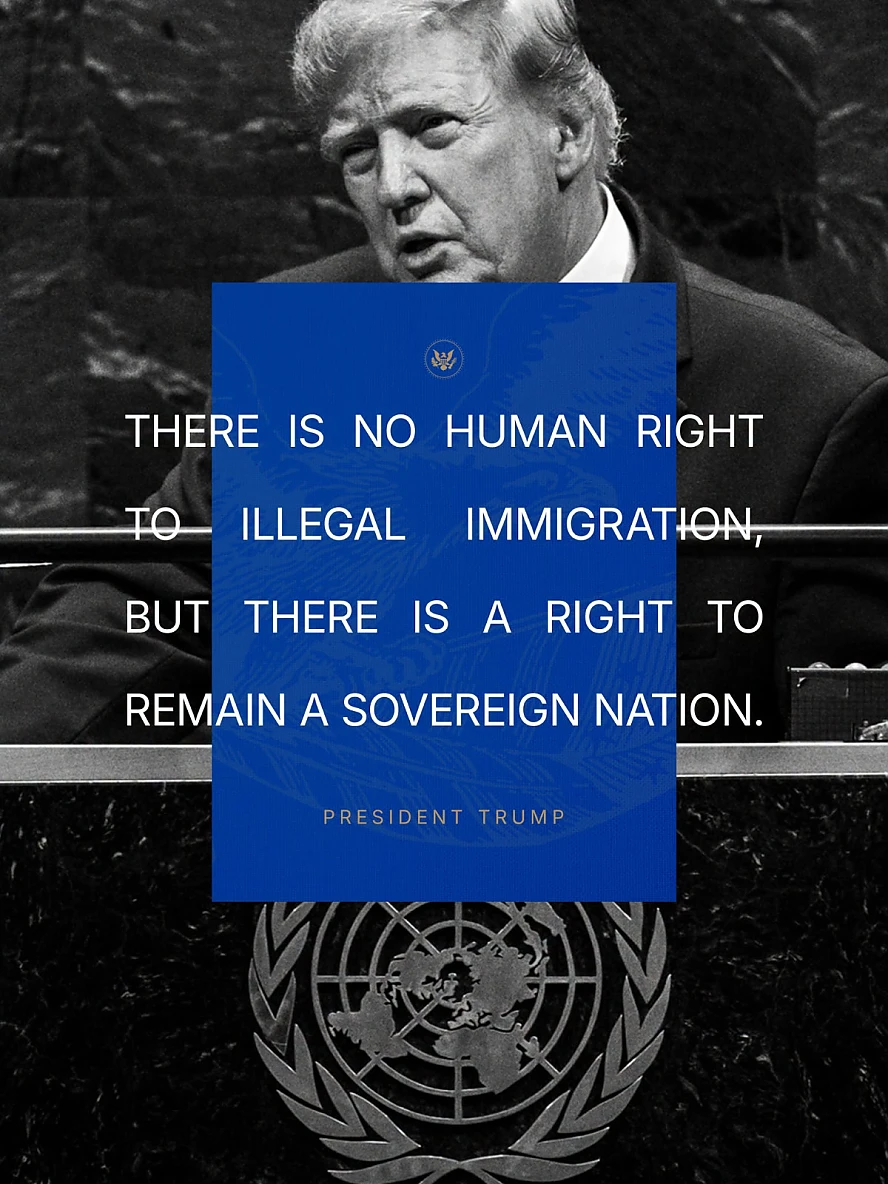
Trump’s message to the 81st session of the General Assembly was that sovereignty comes first, international institutions are legitimate only when they remain accountable to nations, and the United States under his presidency will not subordinate itself to systems of global governance it does not control.
The migration argument was among the speech’s most forceful passages. Trump accused globalists of wanting to open borders to gangs and criminals from the world’s most dangerous places, declaring that America would no longer accept what he characterized as “the worst people from the worst places”, and he wove the theme of Christian persecution into his critique, charging that the UN Human Rights Council has little to say about crimes committed against Christians by the world’s most repressive regimes.
He also returned to cultural themes, denouncing what he called “trans insanity,” and he dismissed climate change in the same sweeping terms he has used before, casting international climate policy as a con and a burden on national prosperity. On artificial intelligence, he rejected the global push to regulate the technology, saying he would not stifle the growth of something he believes will be bigger than the Industrial Revolution and arguing that the only guardrails AI needs are a strong and smart American president.
The sharpest moment of the speech concerned Iran, and it carried the weight of an active war. Trump described the Iranian government as behaving badly not out of strength but out of weakness and desperation, and predicted a world soon free of “five decades of Iranian terror”. He called on Tehran to fully reopen the Strait of Hormuz and return to negotiations, while openly weighing the alternative: a choice between a deal that would allow Iran to rebuild into one of the great countries of the region, or, in his words, “annihilating the Islamic Republic quickly and denying it any further chance to threaten others”. It was an extraordinary thing to say from the podium of an institution founded to prevent war, but Trump has been and, clearly, still is the disruptor of an establishment that spans both the international institutions before him and the deep state at home, the permanent bureaucracy, the courts and agencies working to frustrate the will of the people who elected him.
This was a fearless articulation of national sovereignty and common sense against a self-serving globalist class. The reception in the hall reflected the approach of other leaders has changed as well. Where once Trump’s UN appearances were met with audible laughter, his recent addresses have been received in a heavier silence, a change some read as the sound of a chastened institution and others as the discomfort of leaders listening to an argument they cannot easily answer. Empty seats in some delegations, including Cuba’s, which Trump accused of coordinating with left-wing radicals and communist networks inside the United States, marked the walkouts and boycotts that now accompany his speeches. Whatever one makes of the substance, one thing was clear: the leader of the country that hosts the United Nations and remains its largest funder stood at its rostrum to tell the assembled nations that the entire project of global governance they represent is a failure to be dismantled.
But, if one thinks his speech isolates the US from the rest of te world, it’s worth mentioning that, recently, Trump signed a new trilateral security agreement with Denmark and Greenland that expands the American military presence in the Arctic and strengthens restrictions on strategic access by non-NATO powers. Both the White House and independent reporting described it as a significant expansion of the American security role in Greenland. That is not the behavior of a country withdrawing from the world. It is the behavior of an administration attempting to redefine the terms on which the United States participates in it.
Trump’s fundamental contention is that institutions become dangerous when their legitimacy is treated as self-evident. International organizations, bureaucracies, courts and regulatory structures may have been created for specific purposes, but that does not mean they should operate indefinitely without political scrutiny. Nor does the fact that an institution is international automatically make its decisions more legitimate than those of elected national governments.
And that question is even larger than Donald Trump. Across Europe and North America, confidence in political institutions has weakened while the authority of administrative bodies, courts, international organizations and regulatory agencies has expanded. The resulting tension has produced one of the defining political conflicts of the present era: whether sovereignty ultimately belongs to voters acting through nation states, or whether increasingly complex global problems require authority to migrate toward institutions insulated from electoral politics. President Trump has chosen his side with unusual clarity. His answer is that sovereignty belongs to nations and, through them, to their citizens.
But the UN speech made clear that his target is no longer merely Washington bureaucracy, but the entire architecture of supranational authority. The ICC claims jurisdiction in the service of international justice. UN agencies establish norms covering migration, human rights, climate and development. Governments and international organizations are debating increasingly ambitious forms of coordination over artificial intelligence. For Trump, the question running through all of them is the same: who gave these institutions the authority, who controls them, and what happens when their decisions conflict with the democratic choices of sovereign countries?
It is an argument with considerable political force precisely because the United Nations itself is currently debating its effectiveness. Opening this year’s General Assembly, its president, Khalilur Rahman, acknowledged that people increasingly ask not whether the UN exists but whether it works. He called for institutional reform, greater accountability and renewed trust, while defending the organization as indispensable. Trump and the UN establishment therefore begin from one point of agreement and arrive at radically different answers. Both recognize a crisis of confidence. The UN response is reform in order to strengthen multilateralism, and Trump’s response is to return authority to sovereign states.
Trump’s desired world is one in which international institutions remain tools rather than authorities. Cooperation continues, but sovereignty is not pooled indefinitely. Alliances survive when they produce concrete security. Trade is legitimate when it produces reciprocal benefits. International courts do not supersede American constitutional authority. Migration policy belongs to nations. Artificial intelligence remains subject primarily to national strategy rather than an emerging global regulator. And diplomacy is backed not by the promise that every dispute can be absorbed into an international institution, but by military and economic power.
The White House summarized the distinction in simpler terms: while others have talked, Trump has acted. And this accurately captures how Trump wants the world to understand his presidency. His critics will continue to argue that the approach weakens institutions designed to constrain the arbitrary use of power. But, they cannot deny the fact that those institutions themselves accumulated too much power without sufficient democratic consent. That dispute will not be settled in one General Assembly speech, but Trump has ensured that it can no longer be avoided.
At seventy-nine years old, after two presidential victories separated by one electoral defeat and almost a decade at the center of Western political conflict, Trump has returned to the United Nations not as a politician seeking acceptance from the international establishment, but as the leader of the world’s most powerful state openly questioning many of its assumptions. The globalist order, Trump said, is on notice, and he intends to spend the remainder of his term tearing down what he can of it, at home and abroad alike.